
100+ hospital courses, ready to assign
Every course on the MedSkills LMS with e-learning content for hospitals — mandatory, accreditation-driven and skill-building. Designed to improve NABH compliance, build competent clinical teams, reduce clinical errors and help you avoid medico-legal complications.
The price is shown on each course. Every course includes assessment and a certificate on completion. Bundled and volume pricing available for whole-team, multi-department and multi-branch rollouts. Ask for a plan →
Bachelor Dialysis of Therapy Technology (B.DTT)

Communication and Soft Skills - B.DTT
This course develops interpersonal communication and workplace skills for collaborative healthcare. Learners practise active listening, empathy, clear explanations, feedback and conflict resolution. Simulated patient and team interactions help them adapt language to the audience, manage difficult conversations and reflect on their own communication habits. Examples are adapted to dialysis services and continuity of long-term care.
Basic Computers and Information Science - B.DTT
This course builds foundational computer and information-literacy skills for healthcare learners. It covers hardware and software concepts, file organisation, office applications, internet searching and basic digital security. Learners practise using simulated data to produce documents and spreadsheets and to locate, assess and share information responsibly. Examples are adapted to dialysis services and continuity of long-term care.
Principles of Management - B.DTT
This course introduces the management functions used to organise healthcare services and teams. Learners examine planning, staffing, scheduling, resource use, coordination and performance review. Practical scenarios develop an understanding of how clear responsibilities and realistic priorities support reliable services and constructive teamwork. Examples are adapted to dialysis services and continuity of long-term care.
Medical Electronics for Health Sciences - B.DTT
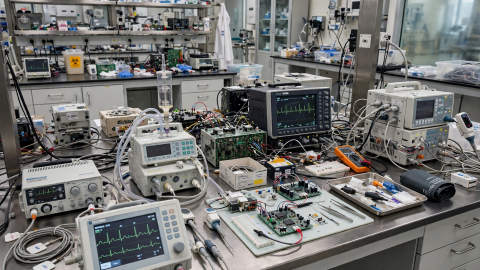
This course introduces electrical and electronic principles used in healthcare equipment. Learners study basic circuits, signals, sensors, transducers and monitoring systems, with emphasis on equipment awareness and electrical safety. Virtual demonstrations and fault scenarios build understanding of routine checks and the distinction between user-level observations and work requiring biomedical engineering support. Examples are adapted to dialysis services and continuity of long-term care.

Medical Law and Ethics - B.DTT
This course introduces the ethical and legal concepts that guide responsible healthcare practice. It addresses consent, privacy, confidentiality, duty of care and professional boundaries using case discussions. Learners practise recognising dilemmas, documenting concerns and identifying when a matter requires advice or escalation through institutional procedures. Examples are adapted to dialysis services and continuity of long-term care.
Sociology in Health Care - B.DTT
This course explores how social circumstances influence health, illness experiences and access to care. Learners examine family structures, culture, socioeconomic disadvantage, stigma and social support. Case-based activities build awareness of the barriers patients face and encourage respectful communication and coordination with appropriate support services. Examples are adapted to dialysis services and continuity of long-term care.

Professionalism and Values & Indian Constitution - B.DTT
This course examines professional values alongside the constitutional principles that inform public life and equitable healthcare in India. Learners consider dignity, equality, duties, accountability and respect for diversity through workplace cases. It links responsible professional behaviour with the practical recognition of discrimination, unfair treatment and the need for appropriate escalation. Examples are adapted to dialysis services and continuity of long-term care.
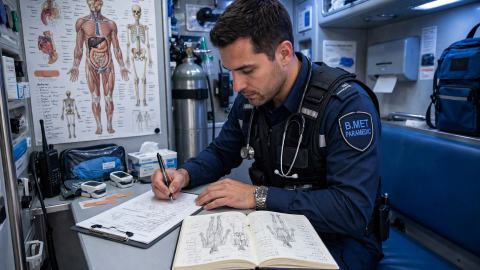
Medical Terminology and Record keeping (including anatomical terms) - B.DTT
This course develops the vocabulary and documentation habits needed for accurate healthcare communication. It covers medical word construction, anatomical directions, common abbreviations and the structure of clinical records. Learners practise interpreting terms and preparing clear, chronological entries while recognising confidentiality, traceability and the risks of ambiguous abbreviations. Examples are adapted to perioperative care and theatre-team coordination.

Introduction to Healthcare Delivery System in India - B.DTT
30h
Bachelor of Anaesthesia & Operation Theatre Technology (B.AOTT)
Health Care Quality & Patient Safety - B.AOTT
This course introduces quality improvement and patient safety as everyday responsibilities in healthcare. Learners explore identification errors, infection prevention, communication failures and incident reporting through simulated cases. Basic improvement tools help them examine a process, recognise preventable risks and suggest measurable changes within their professional role. Examples are adapted to perioperative care and theatre-team coordination.
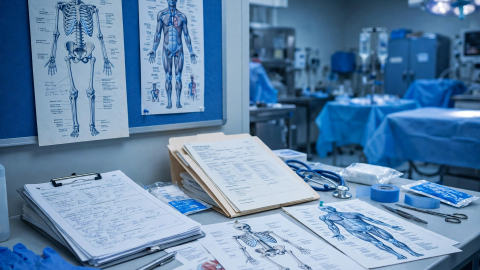
Medical Terminology and Record keeping (including anatomical terms) - B.AOTT
This course develops the vocabulary and documentation habits needed for accurate healthcare communication. It covers medical word construction, anatomical directions, common abbreviations and the structure of clinical records. Learners practise interpreting terms and preparing clear, chronological entries while recognising confidentiality, traceability and the risks of ambiguous abbreviations. Examples are adapted to perioperative care and theatre-team coordination.
Basic Computers and Information Science, Communication and Soft Skills - B.AOTT
This course combines digital literacy with communication and interpersonal skills for healthcare study and practice. Learners work with documents, spreadsheets, presentations and information sources, then use these tools to communicate clearly with patients and colleagues. Activities emphasise responsible data handling, accessible explanations, teamwork and professional online behaviour. Examples are adapted to perioperative care and theatre-team coordination.

Medical Law and Ethics, Professionalism & Values, Principles of Management - B.AOTT
This integrated course connects medical ethics, professional conduct and the management of healthcare work. It explores consent, confidentiality, accountability, professional values and team responsibilities alongside planning and resource coordination. Case discussions encourage learners to recognise ethical concerns, work within role boundaries and organise services with respect for patient dignity. Examples are adapted to perioperative care and theatre-team coordination.
Bachelor of Emergency Medical Technology (B.EMT)
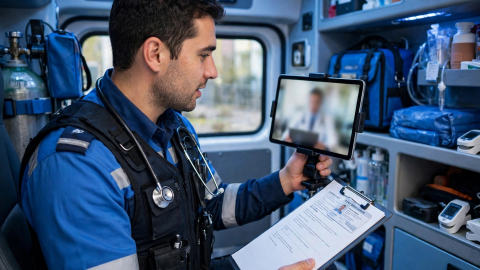
Telemedicine - B.EMT
This course introduces remote healthcare communication and the workflows that support it. Learners explore appointment preparation, identity checks, consent, privacy, documentation and the technical quality of a remote encounter. Simulated cases build awareness of the limitations of remote assessment and the need to arrange in-person care or escalation when appropriate. Examples are adapted to prehospital and emergency-care teamwork.
Healthcare Management: Personality Development, Leadership, Human Rights - B.MET
This course links healthcare management with self-development, leadership and respect for human rights. Learners examine personal strengths, professional behaviour, team motivation and the organisation of services. Case activities develop an inclusive approach to leadership, prioritisation and conflict resolution, with attention to patient dignity and fair treatment. Examples are adapted to prehospital and emergency-care teamwork.
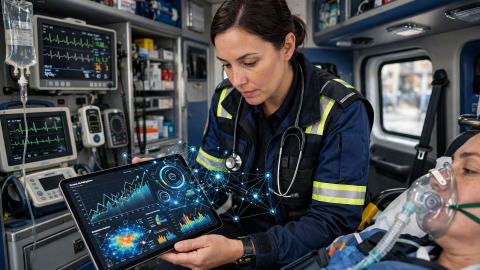
Introduction and Application of Artificial Intelligence in Healthcare - B.EMT
This course introduces artificial intelligence concepts and their possible uses in healthcare. Learners explore how data support prediction and decision-support systems, and how bias, privacy, poor validation and misleading outputs can limit their use. Guided examples emphasise critical appraisal, human oversight and responsible evaluation rather than independent clinical decision-making. Examples are adapted to prehospital and emergency-care teamwork.
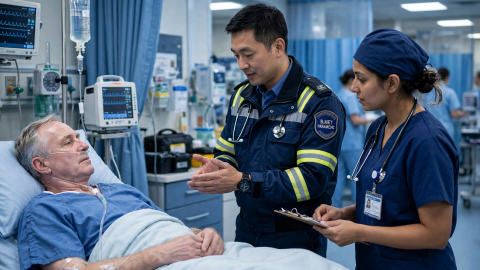
Soft Skills and Clinical Communication Skills - B.EMT
This course applies interpersonal skills to challenging clinical communication. Learners practise structured handovers, empathetic explanations, de-escalation and team communication under pressure. Simulations focus on listening, confirming shared understanding and responding appropriately to distressed patients or relatives while maintaining professional boundaries. Examples are adapted to prehospital and emergency-care teamwork.

Indian Culture, Heritage, Yoga & Meditation - B.EMT
This course explores Indian cultural traditions, heritage and diversity in relation to respectful personal and professional conduct. It introduces yoga and meditation as topics of wellbeing education, with attention to safe participation and individual preferences. Reflection activities encourage cultural sensitivity and awareness of how stress and personal assumptions can affect professional interactions. Examples are adapted to prehospital and emergency-care teamwork.
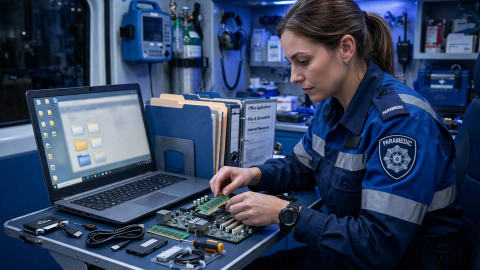
Basics of Computers - B.EMT
This course builds foundational computer and information-literacy skills for healthcare learners. It covers hardware and software concepts, file organisation, office applications, internet searching and basic digital security. Learners practise using simulated data to produce documents and spreadsheets and to locate, assess and share information responsibly. Examples are adapted to prehospital and emergency-care teamwork.
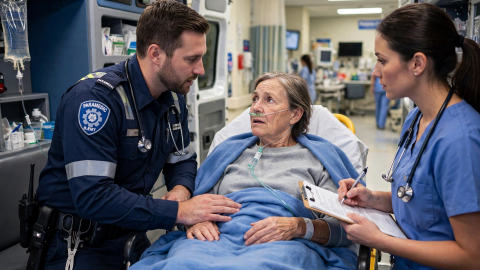
Communication Skills - B.EMT
This course develops the core communication skills used in healthcare learning and patient-facing work. Learners practise attentive listening, plain-language explanations, appropriate questioning and concise written messages. Guided role plays address cultural and language differences and help learners recognise how their tone, body language and choice of words influence understanding. Examples are adapted to prehospital and emergency-care teamwork.
Bachelor of Medical Laboratory Science (B.MLS)

Preventive and Social Medicine - B.MLS
This course introduces the social and preventive dimensions of medicine and the contribution of laboratory services to population health. Learners examine determinants of health, prevention, health promotion and basic epidemiological concepts. Cases link accurate information and laboratory workflows with screening, surveillance and community-service coordination without extending beyond the learner’s professional role. Examples are adapted to laboratory services and accurate information transfer.

Basics of Computer Application - B.MLS
This course develops practical computer skills for medical laboratory learning and routine information tasks. Learners use documents, spreadsheets, presentations and digital information sources with simulated laboratory data. Activities focus on accurate entry, basic calculations, clear presentation, file organisation and responsible handling of confidential information. Examples are adapted to laboratory services and accurate information transfer.

Communication and Professionalism - B.MLS
This course combines clear healthcare communication with the professional behaviours expected in laboratory services. Learners practise respectful interaction, concise written messages, structured information transfer and responses to feedback. Scenarios emphasise accuracy, confidentiality, accountability and collaboration when handling requests, specimens and information within laboratory workflows. Examples are adapted to laboratory services and accurate information transfer.
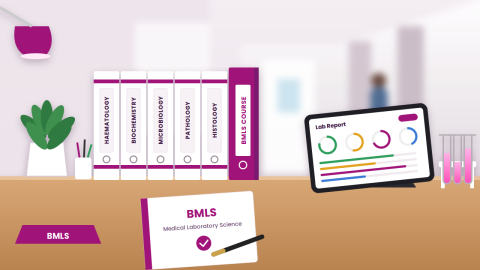
Bachelor of Medical Laboratory Science - B.MLS
BMLS (Bachelor of Medical Laboratory Science) is an undergraduate degree that focuses on medical laboratory testing, disease diagnosis, and healthcare. It prepares students to perform laboratory tests on blood, urine, and other samples to help doctors diagnose and treat diseases.
Bachelor of Medical Radiology and Imaging Technology (B.MRIT)

Principles of Management - B.MRIT
This course introduces the management functions used to organise healthcare services and teams. Learners examine planning, staffing, scheduling, resource use, coordination and performance review. Practical scenarios develop an understanding of how clear responsibilities and realistic priorities support reliable services and constructive teamwork. Examples are adapted to radiology services and patient preparation.

Medical Law and Ethics - B.MRIT
This course introduces the ethical and legal concepts that guide responsible healthcare practice. It addresses consent, privacy, confidentiality, duty of care and professional boundaries using case discussions. Learners practise recognising dilemmas, documenting concerns and identifying when a matter requires advice or escalation through institutional procedures. Examples are adapted to radiology services and patient preparation.
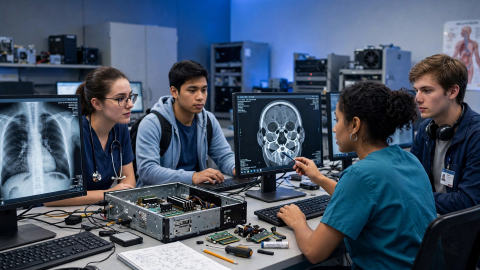
Basic Computers and Information Science - B.MRIT
This course builds foundational computer and information-literacy skills for healthcare learners. It covers hardware and software concepts, file organisation, office applications, internet searching and basic digital security. Learners practise using simulated data to produce documents and spreadsheets and to locate, assess and share information responsibly. Examples are adapted to radiology services and patient preparation.

English & Communication Skills - B.MRIT
This course strengthens English-language skills for academic study and healthcare communication. Learners practise reading, vocabulary, sentence construction, professional writing and spoken interaction. Activities use healthcare scenarios to build clear explanations, concise summaries and confidence in communicating with patients, colleagues and educators. Examples are adapted to radiology services and patient preparation.
Professionalism and Values - B.MRIT
This course develops understanding of professional identity, values and accountable behaviour in healthcare. Learners examine integrity, respect, confidentiality, boundaries and the responsibilities of working in a team. Reflection and case discussion encourage reliable conduct, recognition of personal limitations and constructive use of feedback. Examples are adapted to radiology services and patient preparation.

Medical Terminology and Record keeping - B.MRIT
This course develops the vocabulary and documentation habits needed for accurate healthcare communication. It covers medical word construction, anatomical directions, common abbreviations and the structure of clinical records. Learners practise interpreting terms and preparing clear, chronological entries while recognising confidentiality, traceability and the risks of ambiguous abbreviations. Examples are adapted to radiology services and patient preparation.

Introduction to Healthcare - B.MRIT
This course introduces the purpose, organisation and everyday processes of healthcare services. Learners explore the patient journey, multidisciplinary roles, levels of care and basic quality principles. Case activities connect service structure with communication, referral and coordination, providing a foundation for later professional and clinical study. Examples are adapted to radiology services and patient preparation.
Bachelor of Occupational Therapy (B.OT)

English & Communication Skills - B.OT
This course strengthens English-language skills for academic study and healthcare communication. Learners practise reading, vocabulary, sentence construction, professional writing and spoken interaction. Activities use healthcare scenarios to build clear explanations, concise summaries and confidence in communicating with patients, colleagues and educators. Examples are adapted to rehabilitation and participation in daily activities.

Computer Sciences - B.OT
This course introduces computer systems, structured problem-solving and information handling for occupational therapy learners. It combines basic hardware, software and data concepts with practical use of documents, spreadsheets and digital resources. Learners also consider accessibility and responsible technology use when selecting digital tools for study and service-related tasks. Examples are adapted to rehabilitation and participation in daily activities.

Environmental Sciences - B.OT
This course introduces environmental systems and the links between environmental conditions and health. Learners examine resources, pollution, waste, climate-related pressures and sustainable practices. Healthcare and community examples help them identify environmental barriers and propose practical measures that support health, participation and responsible resource use. Examples are adapted to rehabilitation and participation in daily activities.
Bachelor of Optometry (B.Optom)

Basics of Computers - B.Optom
This course builds foundational computer and information-literacy skills for healthcare learners. It covers hardware and software concepts, file organisation, office applications, internet searching and basic digital security. Learners practise using simulated data to produce documents and spreadsheets and to locate, assess and share information responsibly. Examples are adapted to eye-care services and patient communication.

Data Science for Healthcare - B.Optom
This course introduces the use of data to understand healthcare processes and answer simple questions. Learners practise organising and cleaning simulated datasets, calculating descriptive measures and producing clear visual summaries. The course emphasises data quality, privacy, appropriate interpretation and the difference between observed associations and justified conclusions. Examples are adapted to eye-care services and patient communication.
Innovation and Technology - B.Optom
This course introduces a practical process for identifying healthcare problems and developing useful technology ideas. Learners explore user needs, design thinking, simple prototypes and basic evaluation of feasibility, usability and accessibility. Activities encourage evidence-based problem definition and responsible consideration of privacy, cost and the consequences of adopting new tools. Examples are adapted to eye-care services and patient communication.

Introduction to Quality & Patient Safety - B.Optom
This course introduces quality improvement and patient safety as everyday responsibilities in healthcare. Learners explore identification errors, infection prevention, communication failures and incident reporting through simulated cases. Basic improvement tools help them examine a process, recognise preventable risks and suggest measurable changes within their professional role. Examples are adapted to eye-care services and patient communication.

Behavioral Health Psychology - B.Optom
This course introduces psychological factors that influence health behaviour, adjustment and healthcare experiences. Learners explore motivation, stress, coping, perception and the effects of illness or disability on daily life. Case discussions support empathetic communication and recognition of needs that require referral to an appropriately qualified professional. Examples are adapted to eye-care services and patient communication.

Indian Medicine and Telemedicine - B.Optom
This course introduces major Indian systems of medicine as part of the healthcare landscape and examines the practical organisation of telemedicine. Learners develop respectful awareness of patients’ health beliefs while evaluating information and recognising professional boundaries. Remote-care activities cover communication, consent, privacy, documentation and the limitations of virtual encounters. Examples are adapted to eye-care services and patient communication.

Communication - B.Optom
This course develops the core communication skills used in healthcare learning and patient-facing work. Learners practise attentive listening, plain-language explanations, appropriate questioning and concise written messages. Guided role plays address cultural and language differences and help learners recognise how their tone, body language and choice of words influence understanding. Examples are adapted to eye-care services and patient communication.

Nutrition - B.Optom
This course introduces nutrients, food groups and the principles of balanced nutrition across the life course. Learners explore the relationship between dietary patterns, general health and visual health, including the importance of recognising nutritional concerns. Case activities develop basic dietary awareness and appropriate communication and referral within an optometry role. Examples are adapted to eye-care services and patient communication.
Bachelor of Radiation Therapy Technology (B.RTT)
Principles of Management - B.RTT
This course introduces the management functions used to organise healthcare services and teams. Learners examine planning, staffing, scheduling, resource use, coordination and performance review. Practical scenarios develop an understanding of how clear responsibilities and realistic priorities support reliable services and constructive teamwork. Examples are adapted to radiation therapy services and continuity of cancer care.

Professionalism and Values - B.RTT
This course develops understanding of professional identity, values and accountable behaviour in healthcare. Learners examine integrity, respect, confidentiality, boundaries and the responsibilities of working in a team. Reflection and case discussion encourage reliable conduct, recognition of personal limitations and constructive use of feedback. Examples are adapted to radiation therapy services and continuity of cancer care.

Medical Law and Ethics - B.RTT
This course introduces the ethical and legal concepts that guide responsible healthcare practice. It addresses consent, privacy, confidentiality, duty of care and professional boundaries using case discussions. Learners practise recognising dilemmas, documenting concerns and identifying when a matter requires advice or escalation through institutional procedures. Examples are adapted to radiation therapy services and continuity of cancer care.
Communication and Soft Skills - B.RTT
This course develops interpersonal communication and workplace skills for collaborative healthcare. Learners practise active listening, empathy, clear explanations, feedback and conflict resolution. Simulated patient and team interactions help them adapt language to the audience, manage difficult conversations and reflect on their own communication habits. Examples are adapted to radiation therapy services and continuity of cancer care.

Introduction to Healthcare Delivery System in India - B.RTT
This course introduces the organisation of healthcare in India, including primary, secondary and tertiary services, public and private providers, and referral pathways. Learners examine how financing, workforce roles and access barriers shape the patient journey. Case activities connect health-system concepts with the coordination responsibilities of allied health professionals. Examples are adapted to radiation therapy services and continuity of cancer care.

Biostatistics and Introduction to Research Methodology - B.RTT
This course introduces the foundations of health research and the descriptive statistics used to interpret evidence. Learners develop focused questions, distinguish study designs and explore sampling, bias, measurement and research ethics. Small simulated datasets support calculation and interpretation, while appraisal exercises encourage clear reporting and recognition of study limitations. Examples are adapted to radiation therapy services and continuity of cancer care.
Bachelor of Science in Respiration Technology (B.SRT)
Behavioural Sciences & Clinical Psychology - B.SRT
This course explores behavioural and psychological factors that influence patients’ responses to illness and healthcare. Learners examine stress, coping, motivation, adjustment and the challenges associated with chronic respiratory conditions. Simulated interactions develop supportive communication, recognition of distress and appropriate referral while maintaining clear professional boundaries. Examples are adapted to respiratory services and long-term patient support.

Medical Terminology & Documentation - B.SRT
This course develops the vocabulary and documentation habits needed for accurate healthcare communication. It covers medical word construction, anatomical directions, common abbreviations and the structure of clinical records. Learners practise interpreting terms and preparing clear, chronological entries while recognising confidentiality, traceability and the risks of ambiguous abbreviations. Examples are adapted to respiratory services and long-term patient support.
Community Health & Preventive Medicine - B.SRT
This course introduces community health and the prevention of disease at individual and population levels. Learners examine determinants of health, levels of prevention, health promotion and the organisation of community services. Respiratory-health examples support the design of clear education messages and appropriate referral, with attention to environmental and occupational influences. Examples are adapted to respiratory services and long-term patient support.

Communication Skills & Health Informatics - B.SRT
This course connects effective healthcare communication with the use of digital information systems. Learners examine structured handovers, electronic records, data quality and responsible information sharing. Simulated workflows show how clear messages and accurate digital entries support continuity of care and how communication or information-system failures can create risks. Examples are adapted to respiratory services and long-term patient support.
Cardiac Nursing
Cardiac Pacing, Devices, Electrophysiology and Cardiac Rehabilitation
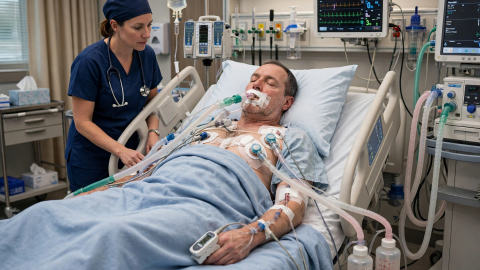
A 68-year-old man with a dual chamber pacemaker is listed for magnetic resonance imaging and the nurse cancels the scan on the grounds that pacemakers and MRI are incompatible; the device is MRI-conditional, the card in his wallet says so, and the scan is deferred by eleven weeks. The course covers pacing indications, temporary and permanent pacing, defibrillators and resynchronisation, device follow-up, electrophysiology, cardioversion, ambulatory monitoring, rehabilitation and secondary prevention.
Cardiothoracic and Post-Cardiac-Surgery Nursing
At 0300 a patient six hours after coronary artery bypass grafting is extubated by protocol. Nobody looked at the chest drain, which had recorded zero output for two hours, charted as zero and read as reassuring; the drain was clotted and the patient was tamponading. The course covers the operations, cardiopulmonary bypass physiology, handover from theatre, the hourly post-operative assessment, drains, tamponade, arrhythmia and pacing, vasoactive and mechanical support, extubation, wounds and the ward phase.
Cardiac Catheterisation Laboratory Nursing
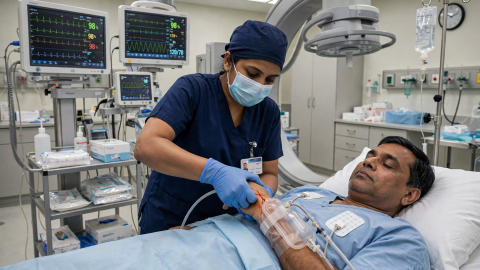
Four events, all of them real patterns rather than rare accidents: a radial sheath removed by a nurse never taught compression, a femoral site not inspected until the morning handover, a contrast reaction with the adrenaline in another room, and dosimeters left unworn in a drawer. The course covers the laboratory environment, radiation protection under AERB regulation, patient preparation, waveforms, angiography and intervention, access site management, laboratory emergencies and governance.
Heart Failure, Hypertension and Cardiac Pharmacology
A 61-year-old woman is admitted for the fourth time in twelve months with breathlessness and oedema. Three discharge summaries recommend daily weights; there is no weight chart in any admission, and she cannot name the eleven tablets in her cloth bag. The course covers heart failure pathophysiology, the nurse-led congestion assessment, diuretic and disease-modifying therapy, hypertension beginning with measurement, cardiac pharmacology, high-alert infusions and nurse-led follow-up.
Acute Coronary Syndrome and the Chest Pain Pathway
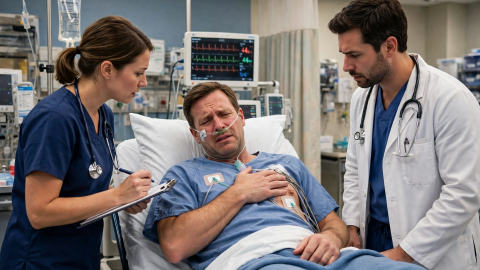
A 44-year-old man walks into the emergency department at 1910 with two hours of central chest pain. He is registered, given a token and seated, and his first electrocardiogram is recorded forty-two minutes later. Door-to-ECG is the one interval in the reperfusion chain owned outright by nursing, and in most Indian hospitals it is not measured. The course covers triage, the chest pain pathway, thrombolysis as a nursing procedure, complications, post-infarct care and secondary prevention.
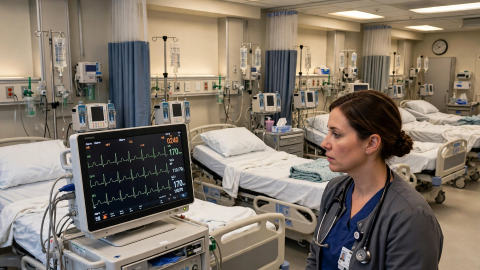
ECG and Arrhythmia Recognition for Nurses
At 0240 a monitor in a six-bedded coronary care unit alarms on a trace that is broad, regular and fast. The nurse silences it, writes nothing and notes that the leads are loose; eleven minutes later the patient is in cardiac arrest and review finds four earlier alarms on the same rhythm, all silenced. This course covers acquiring a technically correct trace, alarm management, systematic reading, the arrhythmias and ischaemia by territory.
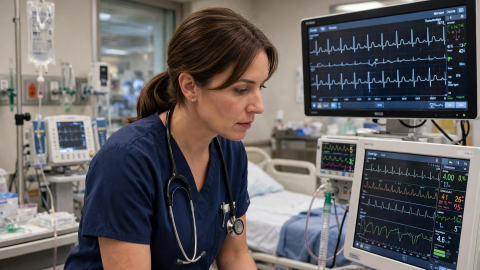
Foundations of Cardiac Nursing: Assessment and Haemodynamics
A nurse in a coronary care unit can read every number on the monitor and cannot say why the blood pressure fell. She reports the systolic, not the pattern; she escalates the alarm, not the finding. Asked whether the problem is volume, pump or vessel, she has no framework to answer with. This course rebuilds that connection - coronary anatomy by territory, the four haemodynamic levers, cardiac examination, monitoring errors, shock differentiation and valvular disease.
General Nursing
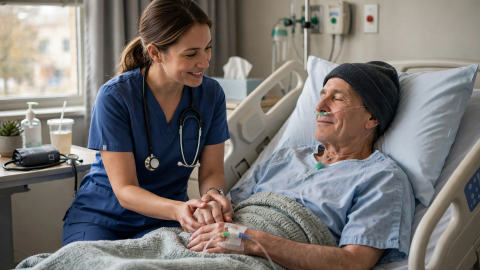
Pain Management, Palliative and End-of-Life Nursing
The chart records a low pain score for a patient with metastatic carcinoma who has had no analgesia since the morning round, and the score was estimated by a nurse walking past a patient lying still because moving hurt. On the same unit a family is told nothing about prognosis for three weeks, then everything in a corridor. This course covers pain assessment, the assessment-to-action gap, opioid practice in India, and end-of-life nursing.
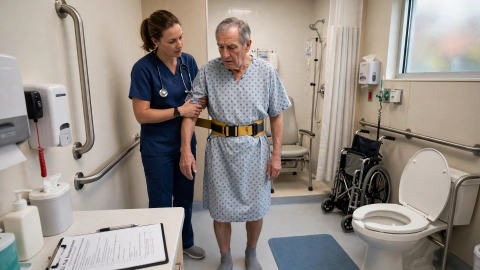
Falls, Mobility, Positioning and Restraint
A patient falls in the bathroom at three in the morning. Her falls risk assessment was completed on admission eight days earlier and never repeated, although she has since started a night sedative, returned from theatre and been moved away from the nursing station. On the next ward a confused man is tied to the bed frame with a bedsheet and nothing is written anywhere. Both are reportable; neither is reported.
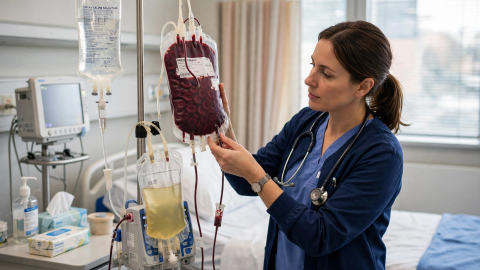
Fluids, Electrolytes, Transfusion and Nutritional Support
A unit of packed red cells is collected from the blood bank at eleven, put on the ward counter because two admissions arrive, and hung at three, with no collection time recorded anywhere. On the next bed a fluid balance chart balances perfectly because the output figures were invented. This course covers fluid requirement and assessment, the honest balance chart, electrolyte disturbance, the transfusion chain, reactions, haemovigilance and nutritional support.
Wound Care, Ostomy and Pressure Injury Prevention
The nursing note reads: bed sore, dressing done. The wound is a full-thickness sacral pressure injury, measured never, photographed never, staged never, and the dressing in use is whatever the ward has in the cupboard. This course builds wound care as an assessment-driven discipline - structured assessment, debridement scope, dressing selection by tissue type, surgical wounds, the diabetic foot, leg ulcers, burns basics, pressure injury prevention and prevalence audit.
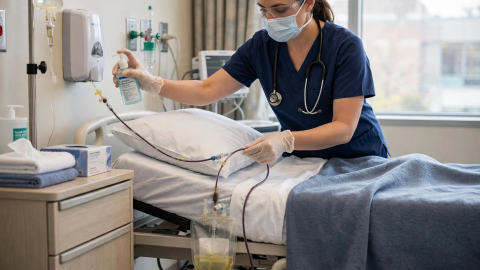
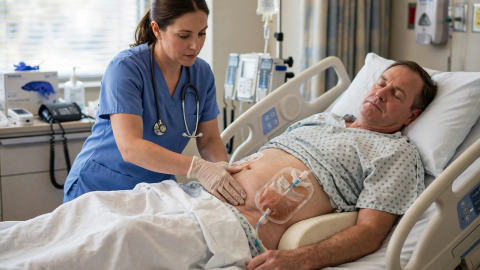
Urinary Catheterisation, Catheter Care and CAUTI Prevention
A catheter is inserted in casualty because the patient is drowsy and output needs watching. She reaches the ward, improves, mobilises, and on day eleven it is still draining because nobody asked the question again - no indication was recorded, so none could expire. This course covers indications and non-indications, alternatives, aseptic insertion, the balloon, the closed system, daily review, nurse-led removal and CAUTI surveillance.
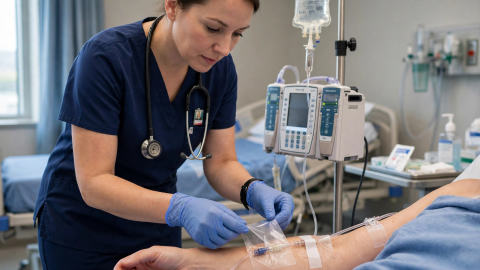
Vascular Access and Infusion Therapy
A peripheral cannula is found in situ on day nine because nobody wrote the insertion date on the dressing or in the record, so no one owned the decision to remove it. On the same ward a central line dressing is changed when it looks dirty and the hub is accessed without being scrubbed. This course covers device selection, insertion, securement, the central line bundle, complication grading, extravasation and a device register.
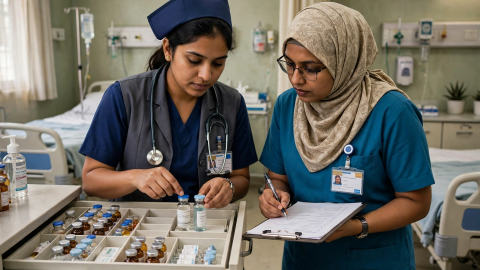
Medication Administration and High-Alert Drugs for Nurses
Open the drug drawer on most Indian wards and the error is already built in: look-alike sound-alike vials side by side, concentrated potassium in ward stock, insulin drawn in a tuberculin syringe, a potassium infusion on a gravity set. Reciting the rights of administration prevents none of it. This course teaches administration as a system of defences - prescription review, independent double-check, high-alert controls, storage, calculation, devices, reconciliation and reporting.
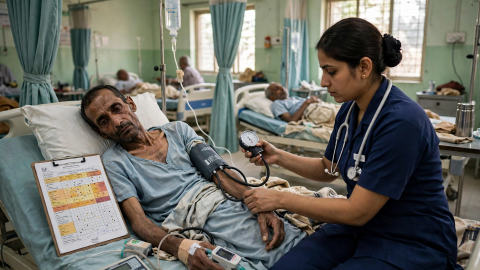
Vital Signs, Early Warning Scores and the Deteriorating Patient
The commonest serious adverse event on an Indian general ward is a patient who deteriorated overnight on a chart recording entirely normal observations - a respiratory rate never counted, a saturation taken on a shut-down finger, an adult cuff on a large arm. The second version is worse: the score was correct and nobody was called. This course covers measurement, early warning scoring, observation frequency, structured escalation and the presentations that kill ward patients.
The Nursing Process, Assessment and Care Planning
On most Indian wards the care plan exists, and that is the problem. It was written on the day of admission, copied from a photocopied template, it names problems that resolved a week ago, and it is produced for the assessor rather than read by the nurse on duty. This course rebuilds the nursing process as a working cycle - assessment, integrated risk screening, problem statements, measurable goals, reassessment, handover, discharge planning and a care plan audit.
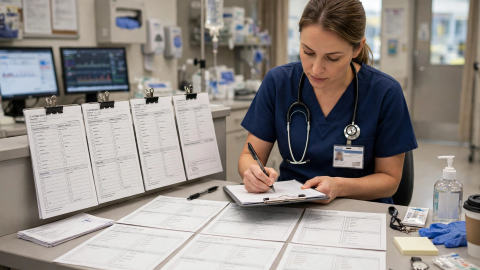
Nursing Documentation, Handover and Clinical Communication
Two failures carry most of the medico-legal exposure a nursing service holds: the entry written at the end of the shift for six patients at once, in which the observations are plausible rather than real, and the handover that transmits the relatives' behaviour and omits the critical potassium result from four hours earlier. This course treats the record as a legal instrument and handover as a structured, auditable clinical procedure.
Infection Control
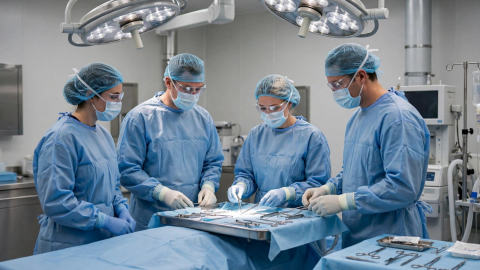
Operation Theatre Infection Prevention and Control
OT infection control is usually taught as scattered fragments - a hand hygiene session here, a CSSD talk there - in the highest-consequence infection environment in the hospital. This course treats the theatre complex as one controlled system: zoning, traffic and attire; pre-operative preparation and antibiotic prophylaxis; intra-operative asepsis; environmental hygiene and air quality; the CSSD interface; and post-operative surveillance. Built on WHO and CDC surgical site infection guidance, NCDC national IPC guidelines and the NABH 6th Edition IPC and COP chapters.
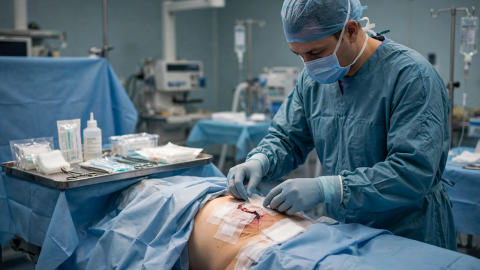
Surgical Site Infection Surveillance and Prevention Bundles
Most hospitals report a surgical site infection rate. Very few can defend how it was calculated - the denominator is unclear, case-finding is passive, and post-discharge follow-up, where many infections appear, is skipped entirely. This course builds genuine surveillance capability: standard case definitions, wound class and risk index, correct denominators, structured case-finding, honest rate calculation, run and control charts for small volumes, and the bundle compliance audit and surgeon feedback loop that moves the rate.
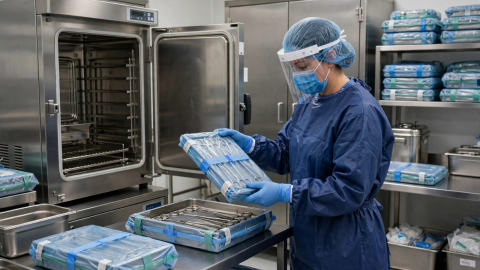
CSSD & Sterilization Practices
A cycle printout is filed with nobody reading the parameters on it, loads are released because the autoclave finished, and instruments reach the department with blood dried on them because point-of-use treatment was skipped in theatre. This course follows the instrument through decontamination, cleaning, inspection, packing, sterilization, storage and issue: zoning and unidirectional workflow, cleaning validation, physical, chemical and biological indicators, load release criteria, packaging integrity, shelf life and recall.
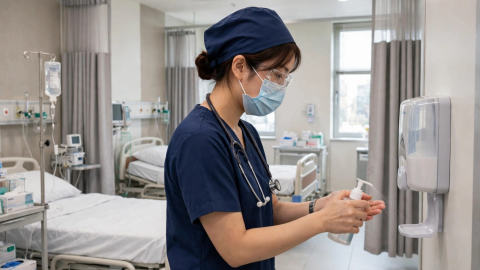
Hospital Infection Prevention & Control (IPC)
Infection control training is often delivered once a year to a hall of staff who sign the attendance sheet and return to practice unchanged. NABH expects in-service infection prevention training at least once a year for every category of staff, and this is the course written to meet it: standard and transmission-based precautions, hand hygiene, personal protective equipment, safe injection practice, device-associated infection, environmental cleaning, waste segregation under the Bio-Medical Waste Management Rules 2016, and outbreak response.
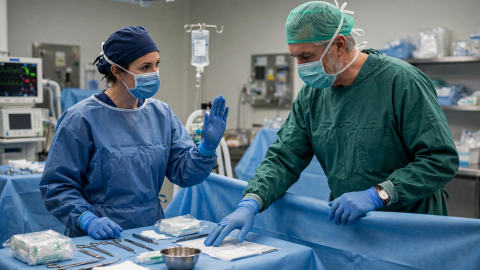
Perioperative Asepsis & Sterile Field Management
The hardest break in asepsis to correct is the one committed by the senior-most person in the theatre, so it usually goes uncorrected. This course is the hands-on companion to the comprehensive OT infection control programme, for the staff who physically create and defend the field: surgical hand antisepsis, gowning and gloving, table setup and draping sequence, sterile field geometry, and the recognition and correction of breaches, including stop-the-line language. It also covers surgical counts, specimen handling, sharps safety and the CSSD handover.
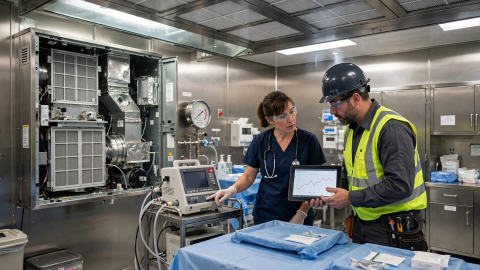
OT Environment, HVAC Validation & Environmental Hygiene
OT air handling is where infection control and engineering meet, and where each defers to the other. Theatres run out of specification for months, validation reports are signed without being read, and vendors supply the cheapest test that yields a passing certificate. This course makes clinical and engineering staff mutually literate: the full parameter set in the NABH Revised Guidelines for Air Conditioning in Operation Theatres (2018), critical reading of a validation report, preventive maintenance, and objective cleaning validation.
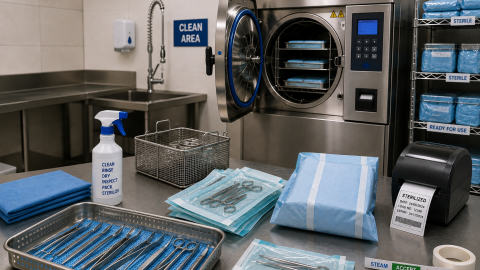
CSSD and Sterilization Practices
Decontamination and sterile-supply standards for CSSD, OT and housekeeping.
Neonatal / NICU Nursing
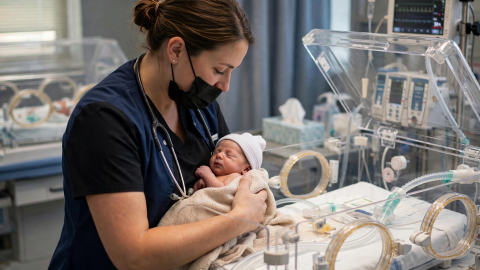
Developmental Care, Neonatal Pain, Family Partnership and Discharge
A 900 gram baby was handled fourteen times in one hour on a morning shift - a nappy change, probe repositions, a heel prick, suction, a weigh, a cannula resite, a radiograph, a round examination and tube feeds - and not one of those procedures was medicated or supported. His mother has held him once in three weeks. This course covers developmental care, neonatal pain, family partnership and discharge done properly.
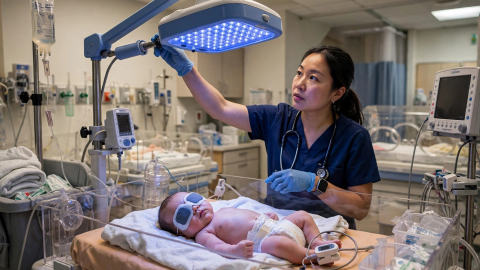
Jaundice, Metabolic, Haematological and Neurological Care
The baby had been under phototherapy for thirty hours with the lamp at whatever height the trolley stood, the eye pads slipped off in the night, the baby swaddled from chest to knee, and the irradiance never measured because the radiometer is in the biomedical store with a flat battery. The notes recorded phototherapy failure. This course covers jaundice, phototherapy as a dose, exchange transfusion, hypoglycaemia, metabolic, haematological and neurological care.
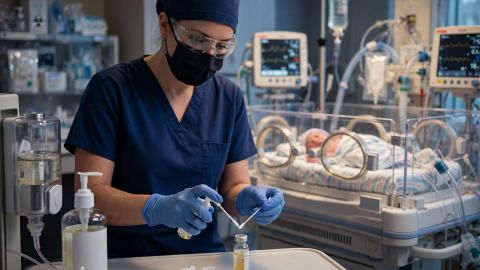
Neonatal Sepsis and NICU Infection Prevention
The Klebsiella outbreak took eleven weeks to recognise and three babies to kill. The investigation found a multidose vial of heparinised saline in use across two shifts and a hand-wash tap whose aerator grew the same organism. In the same unit a baby had a week of meropenem on a blood culture that was never sent. This course covers neonatal sepsis, stewardship, transmission routes, device bundles, outbreak response and surveillance.
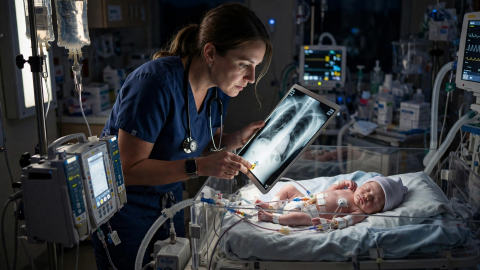
Neonatal Vascular Access, Umbilical Lines, PICC and Fluid Therapy
The umbilical venous catheter was inserted at midnight, the radiograph was taken, and the tip position was never confirmed by anybody because the film was filed and the registrar went to another delivery; parenteral nutrition ran through it for three days. In the next cot opaque tape hid an extravasating calcium infusion until the limb needed plastic surgery. This course covers neonatal fluid therapy, lines, bundles and extravasation.
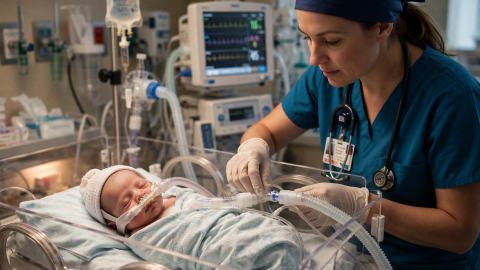
Neonatal Respiratory Support: Oxygen, CPAP and Ventilation
The continuous positive airway pressure prongs were sized by eye from the box that was open; by day four the baby had a notch in the columella and by discharge a permanent septal deformity. In the same unit the saturation alarm limits had been widened so that the alarms would stop. This course covers respiratory physiology, grading of distress, oxygen as a drug, delivery devices, CPAP with its nasal injury bundle, ventilation, suctioning and outcome audit.
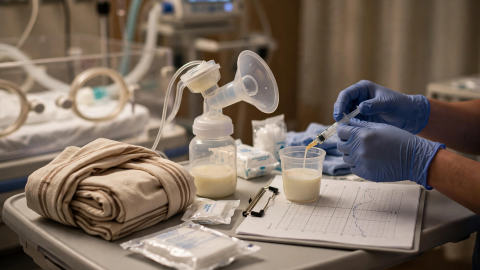
Neonatal Feeding, Lactation, Kangaroo Mother Care and Growth
A mother was separated from her baby for four days because the unit admits babies and not mothers, was given no pump, no private space and no instruction, and was then asked on day five why she has no milk. This course treats lactation and enteral feeding as core neonatal nursing - the first hour, attachment, expression and milk handling, tube feeding, feed intolerance, fortification, donor milk, Kangaroo Mother Care and growth monitoring.
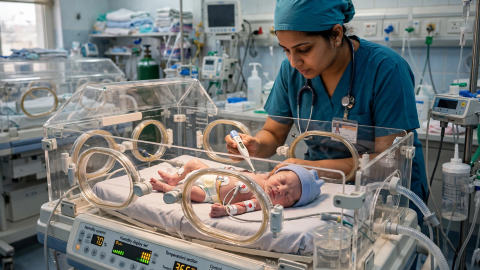
Thermoregulation, Humidity and the NICU Environment
Admission hypothermia is recorded in a large share of preterm admissions in Indian units that own every piece of equipment needed to prevent it. The warmer was on manual with no servo probe attached because the probe covers ran out, and the baby crossed an open corridor in a cold cot. This course covers heat physiology, the routes of heat loss, warmers and incubators, humidity, the delivery room bundle, transport and an admission temperature audit.
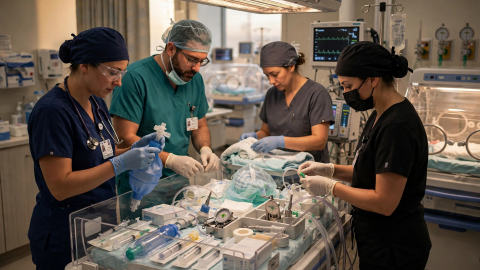
Neonatal Resuscitation and the Golden Hour
The bag-mask had not been checked since the previous shift and the reservoir was split, the towel on the warmer was the one lying there since morning, and ten minutes went on finding a laryngoscope with a working bulb. None of that is a knowledge gap in the person running the resuscitation; it is a system nobody owns. This course covers asphyxia physiology, the pre-birth call and check, ventilation, MR SOPA, compressions, the golden hour and mock drills.
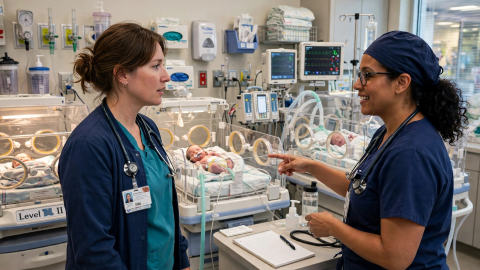
Foundations of Neonatal Nursing and the Levels of Newborn Care
A nurse was moved into the neonatal intensive care unit from a general medical ward on Monday because somebody resigned on Friday, and by Wednesday she is the nurse assigned to a preterm on continuous positive airway pressure. Nobody has told her what a neutral thermal environment is. This course is the induction that unit never ran - transition, classification, the Indian levels of newborn care, assessment, the sick newborn and parent partnership.
Nursing Induction
Preceptorship and Clinical Supervision
Preceptorship in most Indian hospitals is an allocation, not a role. The novice is attached to whichever senior nurse is least busy that week, without notice, training, protected time or an assessment tool. She is either abandoned or never let go, and reaches independent charge either way with a signature saying she is competent. This course treats supervision as a clinical skill with a method, an assessment tool and a record.
Foundations of Safe Nursing Practice
Basic nursing skills in most Indian hospitals are not taught, they are absorbed. The respiratory rate is written down without being counted, the cuff is too small for the arm, intake is recorded and output is not, and the new nurse inherits the technique of whoever was on shift. This course rebuilds the foundation - measurement, identification, hygiene, handling, specimen collection, medication administration, cannulation, oxygen delivery and recognition of deterioration.
Nursing Induction: Role, Accountability and the First Thirty Days
A staff nurse joins on a Monday and is on a ward by Wednesday. She does not know who to escalate to at 2am, what she may do without a written order, or where the crash trolley is kept. This course is the induction she should get - her position under the Indian Nursing Council Act 1947, policy retrieval, escalation by shift, consent, confidentiality under the Digital Personal Data Protection Act 2023, incident reporting, and a signed thirty-day orientation record.
Nursing Leadership
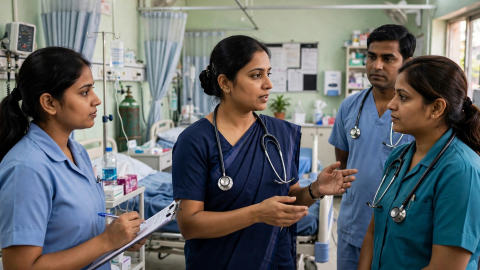
Ward Management and the Nurse In-Charge
The best clinical nurse on the unit is promoted to sister. Nobody trains her. What she knows how to do is clinical work, so that is what she does: she takes the difficult cannulation, the unstable patient and the night-shift gap herself, and has been nursing for eleven hours and managing for none. The course covers the shift as the unit of management, delegation as a legal act, escalation authority, supplies and custody, bed flow, conflict, performance and the incident on your shift.
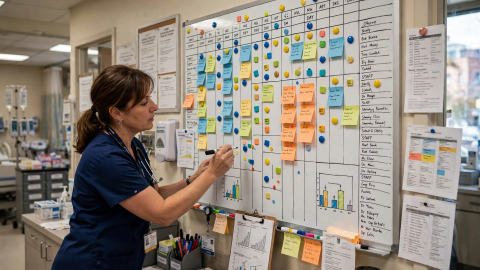
Nurse Staffing, Rostering, Skill Mix and Workload Measurement
The roster is built on who complains loudest. The ward runs at a ratio nobody has measured, because measuring it would require knowing the acuity of the patients in it, and nothing on the unit records acuity. The nursing superintendent knows the department is short and has no number to attach to it. The course teaches the arithmetic: patient classification, workload measurement, establishment calculation, skill mix, rostering, absence, the daily staffing decision and the business case.

Nursing Quality Indicators, Audit and NABH Nursing Compliance
The nursing department reports a fall rate nobody can reconstruct: the numerator comes from incident reports that capture perhaps a third of falls, and the patient-day figure comes from the billing system and includes day-care attendances. The pressure injury rate is zero, reported as an achievement rather than investigated as an impossibility. The course covers nursing-sensitive indicators and their definitions, data collection, run charts, clinical audit, the NABH chapters nursing owns and incident reporting.

Legal, Ethical and Professional Accountability in Nursing
A nurse is served a legal notice twenty-six months after a shift she cannot remember. Her entries say 'general condition fair' at three points, two without a time, the observation chart has a four-hour gap, the escalation she is fairly sure she made appears nowhere, and someone has overwritten a pulse value. The course covers accountability and scope, negligence, the record as evidence, medico-legal cases, consent, confidentiality, mandatory reporting, ethics and speaking up.
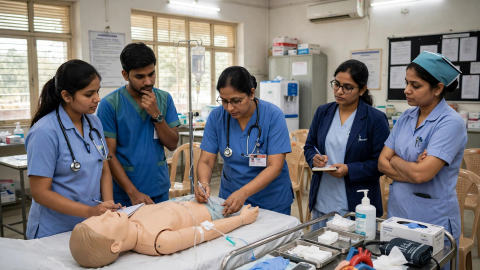
Nursing Education, Competency Assessment and CNE Programmes
The continuing nursing education programme is measured in attendance sheets: twenty-two sessions last year, a signature against each name, a feedback form scoring the speaker. The competency files are full of signed checklists for skills nobody observed. The problem is not that the hospital does not train; it is that training, competence and behaviour change have been treated as the same thing. The course covers training need, objectives, delivery, simulation and debriefing, competency assessment and evaluation.
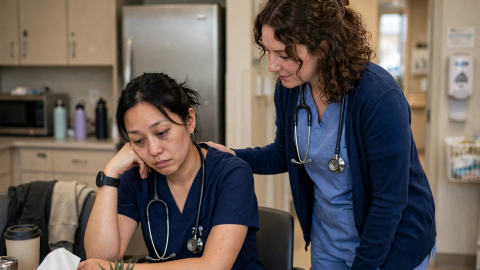
Nurse Wellbeing, Burnout, Workplace Violence and Retention
A ward lost nine nurses in one year, most of them to hospitals paying marginally more. The exit interview form exists; nobody read the nine that were completed. In the same year a staff nurse was slapped by a patient's attendant at two in the morning; the duty officer apologised to the attendant, she filed nothing because no form seemed to apply, and resigned eleven weeks later. The course covers burnout, moral distress, the second victim, shift work, workplace violence, POSH, occupational health and retention.
Paediatric Nursing
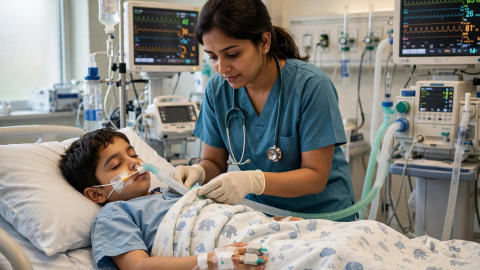
The Sick Child: Recognition, Paediatric Emergencies and Resuscitation
A three-year-old is seen in casualty with two days of diarrhoea. He is tachycardic, his hands are cold to the wrist, capillary refill is prolonged and he has not passed urine since morning. His blood pressure is normal, so he is sent to the ward, where he arrests. The course covers recognition, early warning scoring, triage, shock, status epilepticus, poisoning, burns, trauma, resuscitation principles, trolley preparation and the aftermath.
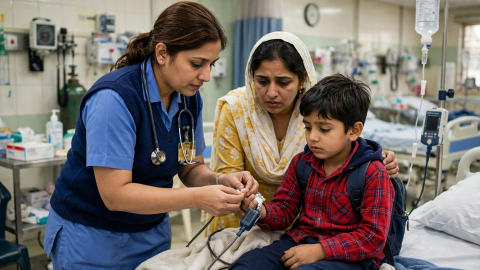
Paediatric Respiratory Care and Oxygen Therapy
A wheezing eighteen-month-old is given oxygen through an adult mask held loosely over his face by a tired mother, and nebulised with the chamber a foot away because he screams when it touches him. The chart records that oxygen and salbutamol were given; neither was, in any dose that matters. The course covers paediatric respiratory assessment, oximetry pitfalls, oxygen as a drug, the main conditions, inhaled therapy technique, airway clearance, tracheostomy and the oxygen-dependent child.
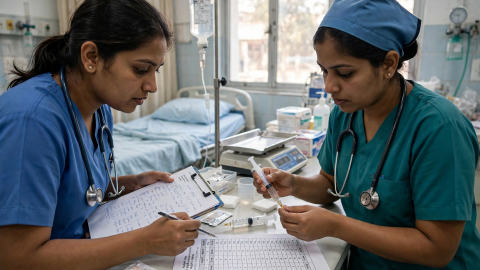
Paediatric Medication, Weight-Based Dosing and Fluid Therapy
A ten-month-old receives ten times the intended dose because a decimal point moved between the prescription and the syringe. In the same week, on the same ward, a child is dosed from a weight taken eight days earlier, another from a weight the mother guessed at triage, and a third from no recorded weight at all. The course covers weighing, weight-based and surface-area dosing, dilution and small volumes, oral liquids, the independent double-check, immunisation and intravenous access, and fluid therapy.
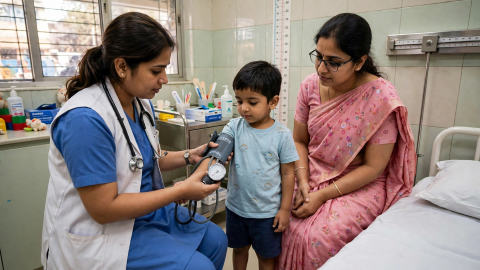
Foundations of Paediatric Nursing: Growth, Development and Assessment
A four-year-old is admitted to a paediatric ward and nursed as a small adult. The blood pressure is taken with the only cuff on the trolley, which is an adult cuff; the observation chart is the adult chart, with no column for work of breathing and no age band against which any number means anything. The equipment is present; the knowledge that makes it useful is not. The course rebuilds paediatric assessment, growth monitoring, nutrition, pain scoring and the child's response to hospitalisation.
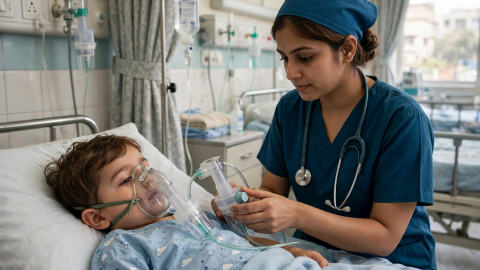
Paediatric Intensive Care Nursing
A six-bedded paediatric intensive care unit on a night shift has two nurses. One has three ventilated children, a vasopressor infusion due to be changed, and a child given a muscle relaxant whose sedation was last scored on the morning round; the tube on bed four is taped at a depth nobody has documented. The course covers monitoring and its artefact, the airway, ventilation, sedation, haemodynamic support, the critical syndromes, bundles and nursing-sensitive indicators.
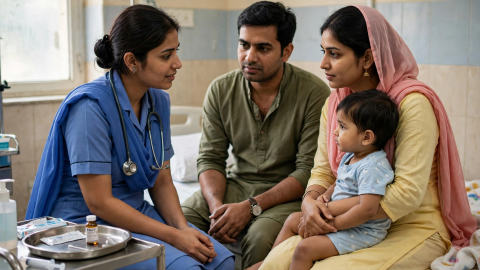
Child Safeguarding, Rights, Family-Centred Care and Immunisation
A two-year-old is brought to casualty with a spiral fracture of the humerus. The history is that he fell from a bed. The nurse notices older bruising in a pattern she cannot explain and says nothing, because she is not sure, and because nobody has ever told her what to do if she is. The course covers child rights and family-centred care, consent, safeguarding and POCSO reporting, documentation for court, immunisation and the cold chain, and child health screening.
Patient Safety

Medication Safety and High-Alert Drugs
Look-alike sound-alike vials sit together in the same drawer, concentrated electrolyte is stored loose on the ward, and a high-alert infusion is started on one nurse's calculation with nobody checking it. This course follows the medication use process from prescription to monitoring: LASA and high-alert identification, segregated storage and labelling, independent double-checks, verbal order read-back, narcotic records under the Drugs and Cosmetics Rules, and reporting of errors and adverse drug reactions.
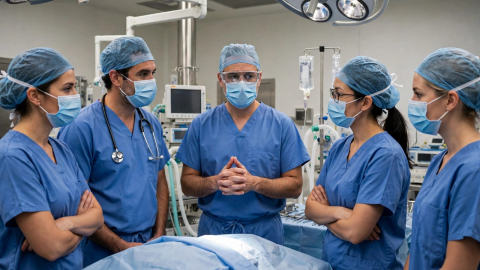
WHO Surgical Safety Checklist and Operating Theatre Safety
The checklist is read aloud by a nurse while the team carries on working, and sign-out is skipped because the surgeon has already left the theatre. This course treats the three pauses of the WHO Surgical Safety Checklist as a team conversation rather than a form: sign-in, time-out and sign-out, who must stop and listen, identity, consent and site marking verification, specimen labelling, instrument and swab counts, anaesthesia checks, and theatre discipline and traffic.
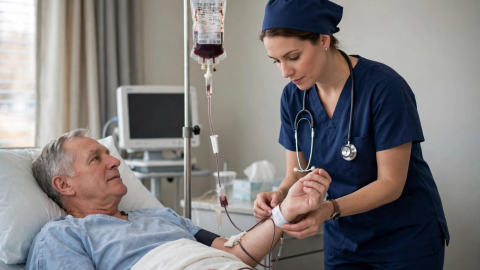
Patient Safety and the International Patient Safety Goals
The patient safety goals are read out at induction and then absent at the bedside: a wristband nobody checks before a transfusion, a shift handover that loses the potassium infusion, an unmarked site because the surgeon always knows. This course works through correct patient identification, effective clinical communication and handover, safe use of high-alert medication, correct site surgery, infection risk reduction and fall risk, as they are actually practised on an Indian ward.
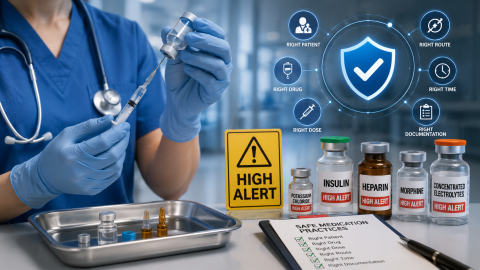
Medication Safety & High-Alert Drugs
Prevent the errors most scrutinised in audits — LASA drugs and high-alert protocols.
Surgical Nursing
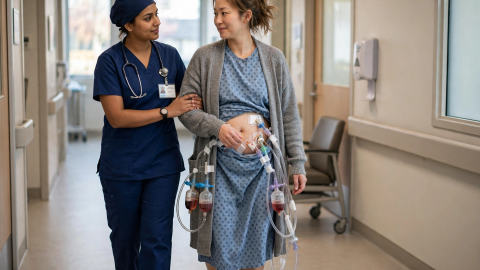
Pre-operative Nursing: Assessment, Optimisation and Preparation
A patient is on the table, draped, when somebody reads the dangerously low potassium result that was taken two days earlier and filed. Another is cancelled because the clopidogrel was never asked about. A consent form for a laparotomy is signed by the patient's brother-in-law, in English, for a woman who reads only Telugu. The course covers pre-assessment, risk and investigation, optimisation, medicines, fasting, consent, site marking and preparation.
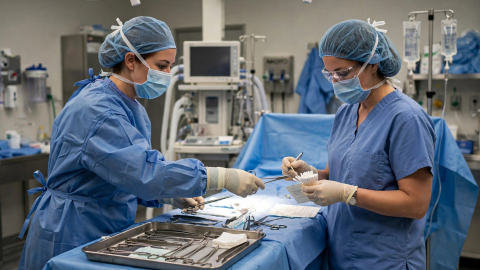
Scrub and Circulating Nurse Practice
The count was declared correct. The swab was under the drape, folded into the pack of five that was counted as four because the scrub nurse was counting from memory and the circulating nurse was answering the intercom. In most Indian theatres this practice is transmitted by apprenticeship, with no written standard and no assessment. The course covers the two roles, case preparation, asepsis, the sterile field, positioning, prep and draping, the count, instruments, energy devices, specimens and implants.
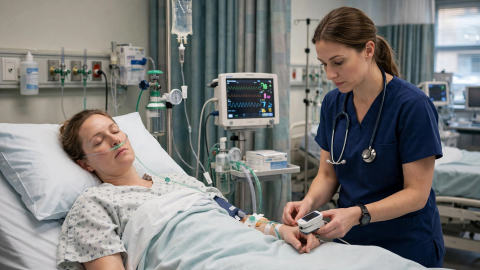
Anaesthesia Support and Post-Anaesthesia Care Unit Nursing
A patient is extubated on the table and wheeled into a bay that has a trolley, a blanket and a borrowed pulse oximeter. There is no oxygen flowmeter, no suction, no capnography and one nurse responsible for six recovering patients and the phone. Twenty minutes later somebody notices snoring respiration. The course covers the anaesthetic nurse role and pre-list check, agents and techniques, airway support, regional and epidural nursing, the recovery unit, scoring and complications.
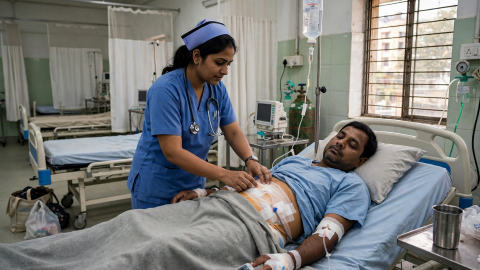
Post-operative Ward Nursing and Surgical Complications
A man is four hours back from a laparotomy. His pulse is charted as rising on three separate rounds by two different nurses, in the correct boxes, in blue ink, and nobody escalates, because nobody has been taught that a rising pulse after laparotomy is a surgical emergency rather than a value to be recorded. He returns to theatre at midnight. The course covers handover, post-operative assessment, early warning scoring, haemorrhage, the complication set, discharge and audit.
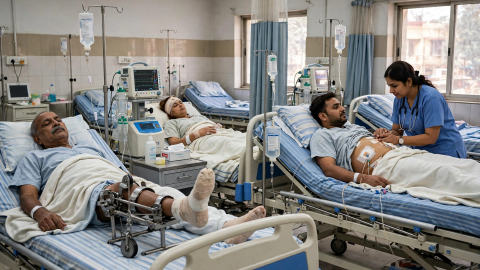
Specialty Surgical Nursing: Orthopaedic, Neuro, Uro, GI and Plastic
A staff nurse is posted to a twenty-eight bed ward that holds eleven orthopaedic patients, four craniotomies, six transurethral resections on bladder irrigation, a free flap, two thyroidectomies and a new colostomy. She has had no training in any of them. This is the commonest staffing reality in Indian surgical services and it is a training problem. The course covers orthopaedic, spinal, neurosurgical, urological, gastrointestinal, breast and endocrine, plastic and burns, ENT, vascular and oncological nursing.
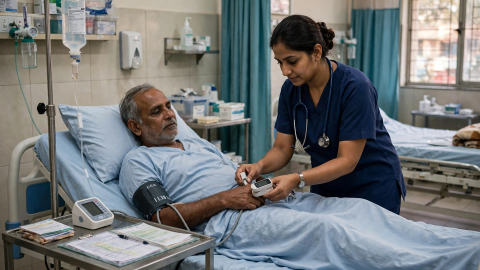
Enhanced Recovery, Day-Care Surgery, Drains, Tubes and Surgical Devices
A woman has a laparoscopic cholecystectomy on Monday morning. She is kept nil by mouth until Wednesday, catheterised because she had an epidural she did not need, kept in bed because nobody is accountable for getting her out of it, and discharged on Thursday with a drain nobody can explain. The operation took forty minutes. The course covers enhanced recovery as nursing work, day-care surgery, drains, gastrointestinal and chest tubes, surgical devices and going home with hardware.
Accreditation & Quality

NABH 6th Edition - Implementation & Compliance
Most hospitals prepare for accreditation by writing policies and then carry on working as before, so the assessor finds a manual that no ward follows. The 6th Edition took effect on 1 January 2025. This course orients the whole hospital to it chapter by chapter - AAC, COP, MOM, PRE, PSQ, IPC, FMS, HRM, IMS and ROM - setting out what each chapter expects of daily practice, which post owns it, and what evidence routine work should already be generating.
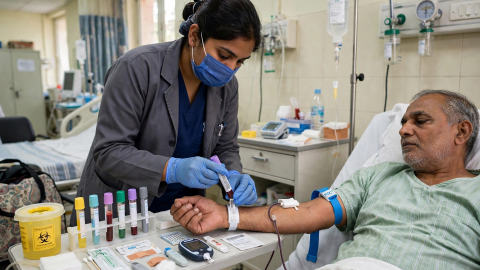
Pre-Analytical Excellence, Phlebotomy Safety & POCT Governance
Most laboratory errors that reach a patient never occur in the analyser: the wrong patient identified, the wrong tube, the wrong order of draw, a prolonged tourniquet, an under-filled citrate tube, a haemolysed sample accepted rather than rejected. This course covers the pre-analytical phase end to end, from requisition and identification through collection, labelling, transport and acceptance criteria, with laboratory biosafety, and the governance of point-of-care testing that ISO 15189:2022 brought into the main standard.
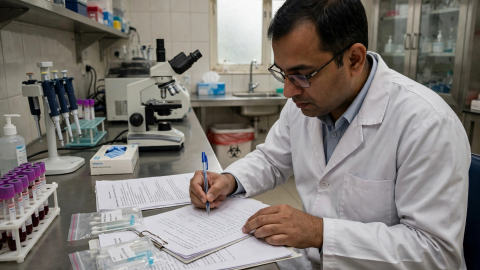
NABL Internal Auditor for Medical Laboratories
Internal audits are routinely conducted by the person who wrote the procedures, checklists are ticked without evidence collected, findings are written as vague observations, and root cause is recorded as staff carelessness. NABL assessors recognise a hollow audit programme immediately. This course produces auditors who work to ISO 19011:2018 principles: independent, risk-based programme design, checklists mapped clause by clause to ISO 15189:2022 and NABL 112, vertical and horizontal audit trails, and nonconformity statements that survive challenge.
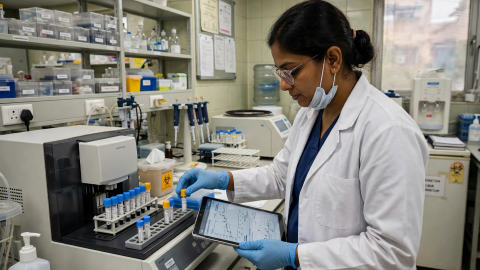
Laboratory Quality Control, EQAS & Method Validation
Control materials are run because the standard operating procedure says so, rules are applied because the analyser arrived configured that way, and failures are repeated until they pass. This course rebuilds quality control from statistical first principles: establishing laboratory-specific means and limits, selecting rules on sigma metrics and allowable total error rather than habit, a disciplined out-of-control response including patient result recall, external quality assessment, method verification, and measurement uncertainty - among the most common NABL nonconformities.
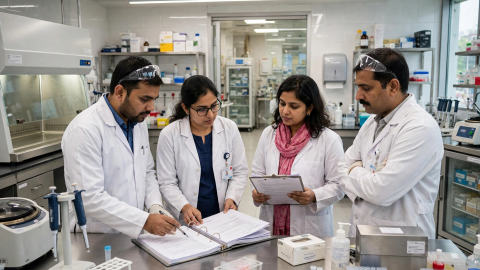
NABL Accreditation & ISO 15189:2022 - Implementation and Documentation
NABL has accepted applications only against ISO 15189:2022 since January 2026; the transition window from the 2012 edition closed on 31 December 2025, and most laboratory staff were trained on the withdrawn version. The revision is structural: five requirement groups, risk-based thinking embedded throughout, sharpened laboratory director accountability, explicit impartiality, and point-of-care testing brought into the main standard. This course takes a laboratory from standard text to a working quality management system, including the NABL 112 and 112A specific criteria.

NABL / Lab Quality for Hospital Labs
Quality-system essentials for diagnostic and pathology teams pursuing NABL.

NABH Nursing Excellence — Certification Prep
Ready your nursing service for the fast-growing Nursing Excellence certification.

Quality Indicators, KPIs & Clinical Audit
Collect, monitor and act on quality indicators — the continuous-improvement discipline most hospitals lack.

Internal Quality Auditor for Hospitals
Build the in-house audit team NABH expects, with a repeatable internal audit method.

NABH Assessment Readiness & Documentation
Face assessors with confidence — SOPs, records and mock-audit practice ahead of every assessment cycle.
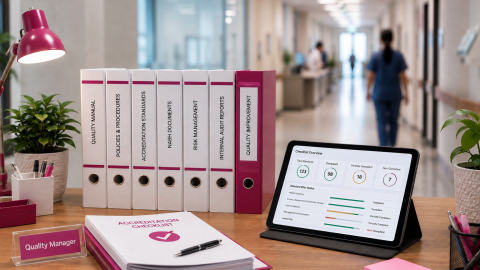
NABH 6th Edition — Implementation & Compliance
Orient your whole hospital to the 639 objective elements and evidence required by the current accreditation standard.
Patient Safety & Clinical Risk
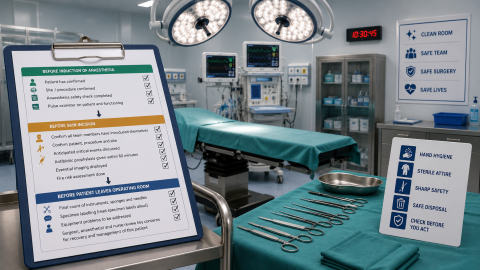
WHO Surgical Safety Checklist & OT Safety
Safer surgery for OT, anaesthesia and surgical nursing teams.
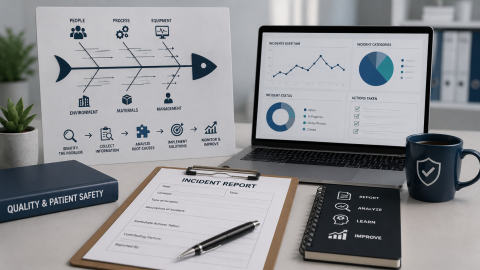
Root Cause Analysis & Incident Reporting
Build a just reporting culture and turn incidents into system fixes.
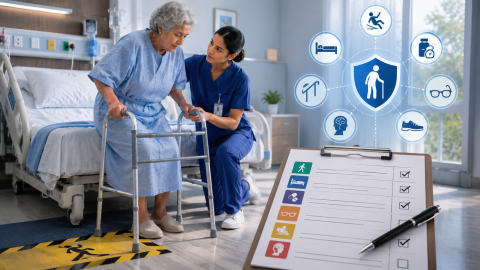
Fall Prevention & Risk Assessment
Assess risk and prevent falls — a common, monitored incident on every ward.

Patient Safety & International Patient Safety Goals
IPSG in practice — correct identification, safe surgery and effective handovers.
Infection Prevention & Control

OT Infection Prevention & Control
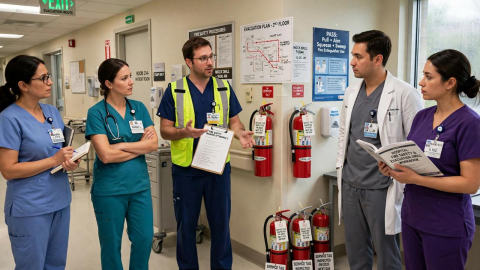
Required for Fire NOC and NABH FMS — response, extinguishers and evacuation.
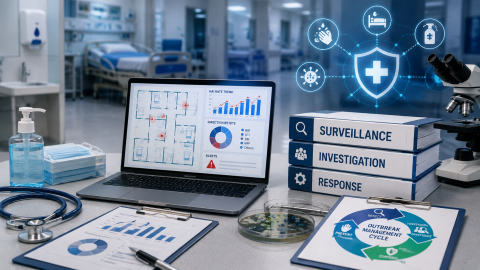
HAI Surveillance & Outbreak Management
Surveillance and response for infection-control nurses and the HIC committee.
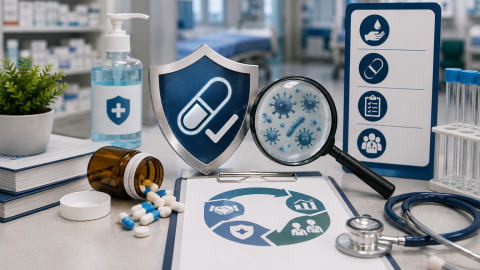
Antimicrobial Stewardship
Combat antimicrobial resistance — appropriate prescribing for doctors, pharmacists and ICU teams.
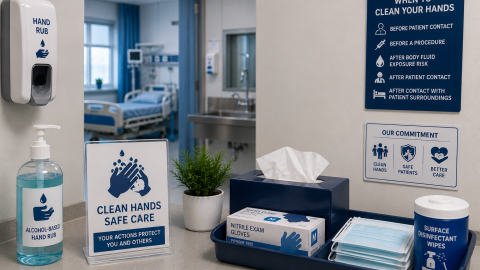
Hand Hygiene & WHO 5 Moments
A short refresher on the practice audited continuously across every ward.
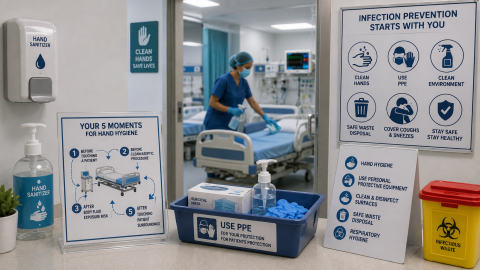
Hospital Infection Prevention and Control
The flagship annual course for all staff — standard precautions, HAIs and outbreak response.
Waste, Fire & Facility Safety
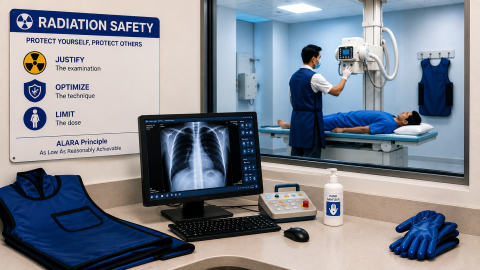
Radiation Safety (AERB) for Imaging Staff
Mandatory safety training for radiology, cath-lab and radiotherapy teams.
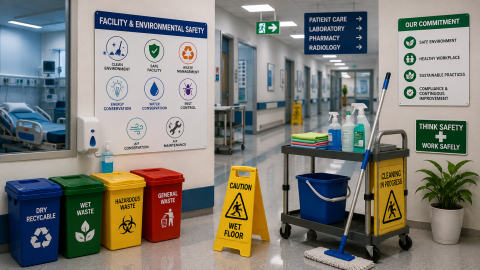
Facility & Environmental Safety (FMS)
Electrical safety, signage and utilities under the NABH facility-management chapter.
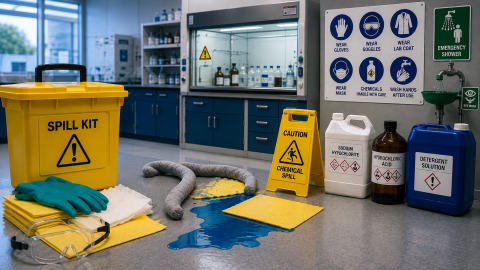
Spill Management & Chemical Safety
Safe handling of spills, mercury and hazardous chemicals across the facility.
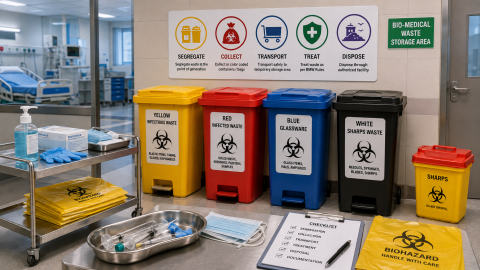
Biomedical Waste Management (BMW Rules 2016)
Four-colour segregation, barcoding and annual reporting — legally required every year.
Medico-Legal & Regulatory Compliance

Patient Data Protection: The DPDP Act and Hospital Records
Protect patient data and meet Digital Personal Data Protection Act duties for health records.
Clinical Establishments Act & Statutory Licensing
Keep registrations, licences and statutory displays in order across the hospital.
PC-PNDT Act Compliance
Meet PC-PNDT obligations for imaging units — non-compliance carries severe legal penalties.

Death Certification
Certify deaths correctly and manage bodies, documentation and difficult conversations.

Medical Negligence & Liability Prevention
Understand duty of care and negligence, and the everyday practices that prevent claims.

Informed Consent: Law & Documentation
Take, document and defend valid consent — high-risk, high-litigation and often done poorly.

Medico-Legal Case (MLC) & Police Case Management
Handle MLCs, police requisitions and evidence correctly — a frequent source of hospital liability.
Nursing Skills & Upskilling
Dialysis Nursing
Skills for the fast-growing dialysis and nephrology service line.
Basic ECG Interpretation for Nurses
Read rhythms and escalate faster — a popular, practical short course.
Nursing Documentation & Handover (SBAR)
Structured handover and documentation — a frequent audit finding, fixed.
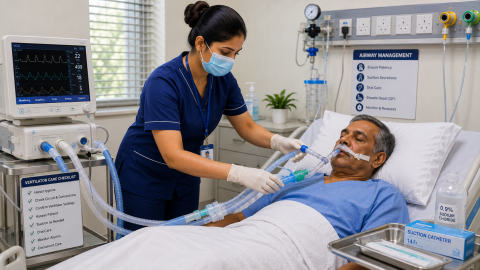
Ventilator Care & Airway Management
Ventilator and airway essentials for ICU, HDU and emergency nurses.
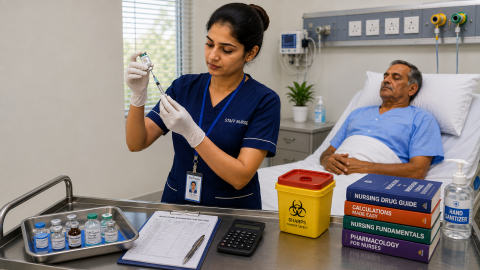
Medication Administration & Dosage Calculation
Reduce the most common nursing error with confident calculation.
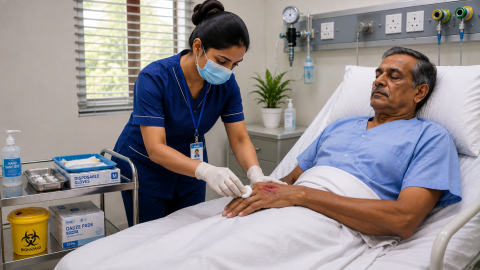
Wound Care & Pressure-Injury Prevention
Assessment and care tied directly to a monitored quality indicator.
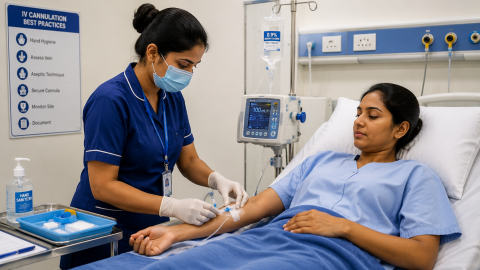
IV Cannulation & Infusion Therapy
A core bedside skill standardised across your nursing workforce.
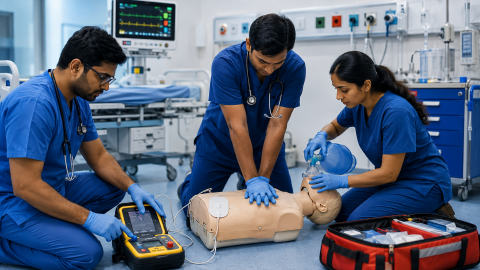
Basic & Advanced Cardiac Life Support (BLS/ACLS)
High-quality CPR, airway basics and rapid response expected of clinical staff.
Emergency & Critical Care
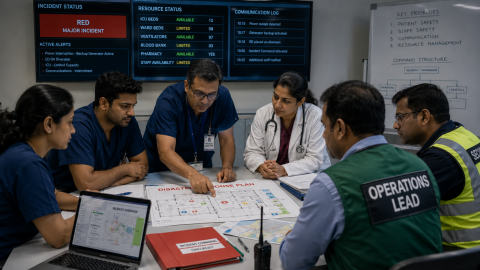
Disaster Management and Mass Casualty Incidents
Disaster preparedness and drills for a coordinated hospital response.
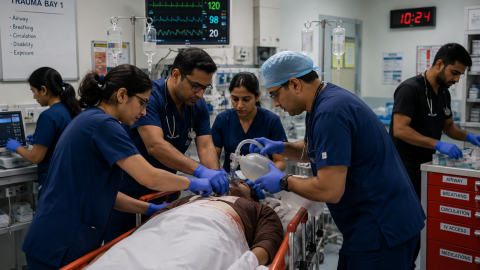
Basic Trauma Management
Initial trauma assessment and stabilisation for ED and surgical teams.
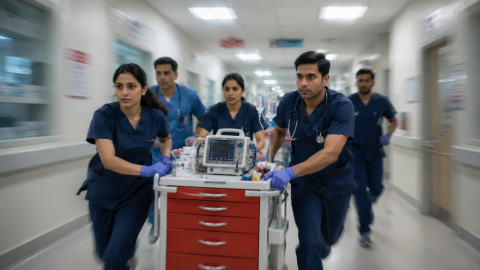
Code Blue, Rapid Response and the Deteriorating Patient
Run effective codes and mock drills — a functioning code team NABH expects.
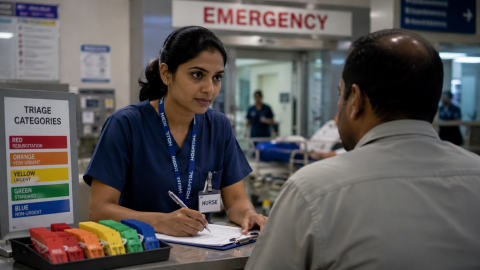
Emergency Nursing And Triage
Rapid triage and prioritisation for casualty and emergency-department staff.
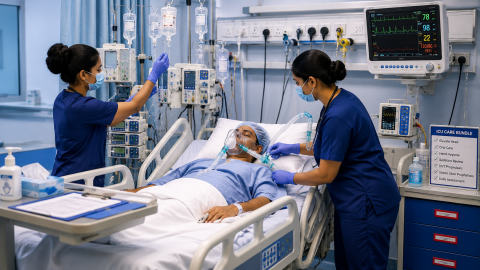
Critical Care and ICU Nursing
Monitoring, ventilated patients and escalation in high-dependency settings.
Specialty & Emerging Clinical
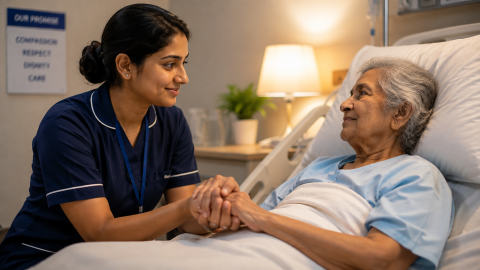
Palliative & End-of-Life Care
Compassionate, skilled care for a growing and under-served need.
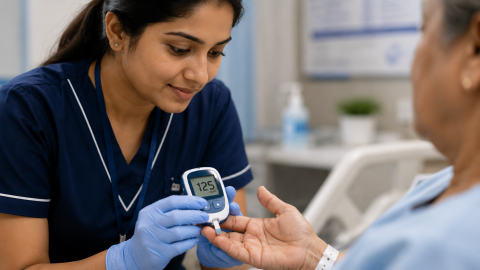
Diabetes Care & Management
Broadly applicable diabetes care for nurses and patient educators.
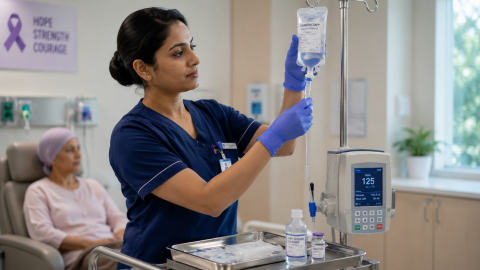
Oncology / Chemotherapy Administration
Safe handling and administration for oncology day-care and wards.
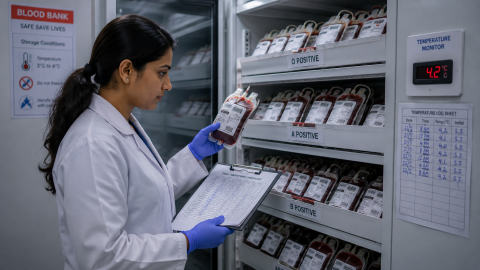
Blood Transfusion Safety & Haemovigilance
Safe transfusion for blood-bank and clinical teams — checks, reactions and reporting.
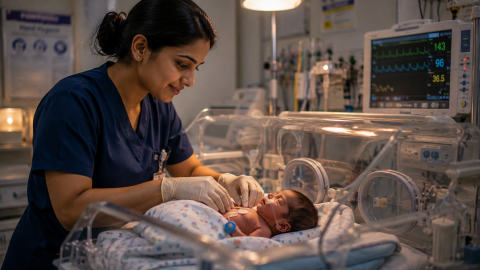
Neonatal Resuscitation & NICU Care
Newborn resuscitation and NICU essentials for obstetric and paediatric units.
Onboarding, Ethics & HR Compliance

Code of Conduct, Ethics & Professionalism
Culture, ethics and professional conduct as a standard onboarding module.
Patient Rights & Responsibilities
A dedicated NABH chapter, for every patient-facing member of staff.

POSH — Prevention of Sexual Harassment
Statutory awareness under the POSH Act, 2013 — for every employee, every year.

Staff Induction & Onboarding Program
A structured orientation for every new joiner — policies, safety and rights from day one.
Patient Experience & Soft Skills
Grievance & Complaint Handling
Resolve complaints well — for front office, PROs and duty managers.
Handling Difficult Patients & De-escalation
Frontline conflict management and safe de-escalation.
Communication Skills & Breaking Bad News
Clear, compassionate communication for doctors and nurses.
Patient Experience & Service Excellence
Lift satisfaction scores, reviews and repeat footfall through better patient experience.
Documentation, Coding & Digital Health

ICD Coding & EMR/HIS Proficiency
Coding and digital-record skills for insurance, analytics and NABH's digital push.
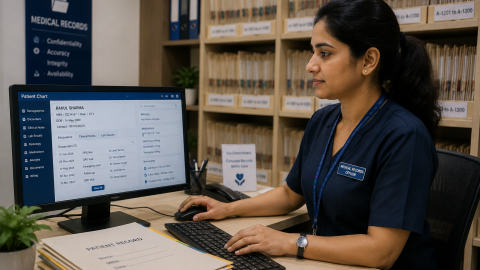
Medical Records & Clinical Documentation
Complete, legible records — a recurring audit finding, addressed head-on.