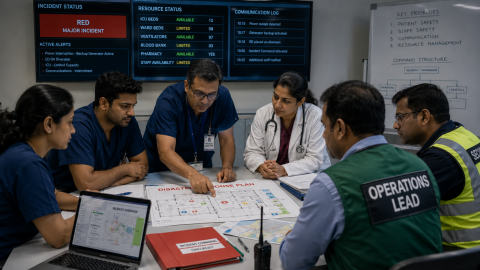
Emergency Nursing And Triage
Rapid triage and prioritisation for casualty and emergency-department staff.
Overview
What this course sets out to do
- To establish triage as a trained clinical decision made by a nurse, separate from registration, billing and the management of the queue.
- To equip emergency nurses to apply a structured triage scale consistently, so that two nurses reach the same category for the same patient.
- To explain the red flag presentations - chest pain, breathlessness, altered sensorium, bleeding and obstetric emergency - that bypass the queue entirely.
- To build the practice of re-triage, so that a patient whose wait lengthens is reassessed rather than quietly forgotten in the corridor.
- To prepare departments to measure triage performance, door-to-assessment intervals and category accuracy as reported quality indicators.
What your staff will be able to do
- Assess an undifferentiated emergency arrival and assign a triage category with a stated reason within the department's own time standard.
- Prioritise a queue of simultaneous arrivals and justify the order chosen against the triage scale rather than against order of arrival.
- Recognise the presentations requiring immediate resuscitation room transfer and initiate that transfer without waiting for a doctor's instruction.
- Design a triage register and a re-triage schedule for the department, with the categories, intervals and escalation points defined.
- Audit completed triage records for category accuracy and waiting interval and report the findings to the head of the department.
Eligibility
Registered nurses with valid State Nursing Council registration posted to casualty, emergency or observation areas, together with emergency medical officers, duty doctors and rapid response team members. Prior experience in an acute clinical area is expected. Triage competence is signed off locally after supervised practice in the hospital's own department.
Renewal & retraining
NABH expects annual refreshers and revalidation for high-risk roles, which includes this unit. Hours count toward the Indian Nursing Council requirement of 150 CNE hours per five-year cycle.
This is an annual requirement — staff must retrain every year and the certificate states when the next refresher is due. Inside the MedSkills LMS, expiring certificates are flagged automatically and refresher training is re-assigned before the due date.
Curriculum
Certification
Upon successful completion of this course, you will receive a tamper-proof digital certificate backed by blockchain technology from MedSkills. This secure, verifiable certificate validates your skills and can be shared on LinkedIn, added to your resume, or included in your professional portfolio.
Certificate Benefits
Blockchain-Backed Security
Tamper-proof certificates secured by blockchain technology
Instant Verification
Employers can verify authenticity instantly through blockchain
LinkedIn Ready
Share directly to your LinkedIn profile and resume
Digital Download
High-quality PDF certificate for printing
Global Recognition
Accepted by employers and institutions worldwide
Lifetime Access
Certificate remains valid and accessible forever
Certification Requirements
- Complete all course modules and assignments
- Achieve minimum 50% score in final assessment