Overview
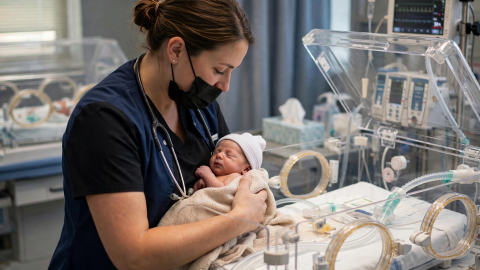
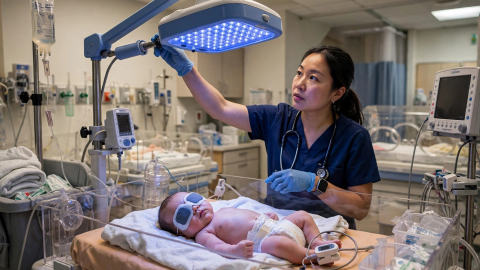
| A nurse was moved into the neonatal intensive care unit from a general medical ward on Monday because somebody resigned on Friday, and by Wednesday she is the nurse assigned to a preterm on continuous positive airway pressure. Nobody has told her what a neutral thermal environment is. This course is the induction that unit never ran - transition, classification, the Indian levels of newborn care, assessment, the sick newborn and parent partnership. |
What this course sets out to do
- To explain newborn transition at birth and why a newborn is not a small adult, with the practical consequences for the nurse at the cot side.
- To establish classification by gestation and weight and the capability of each Indian level of newborn care, from the newborn care corner to Level III intensive care.
- To teach systematic newborn assessment and gestational age assessment, and the danger signs that identify the sick newborn before collapse.
- To establish routine care at birth and the everyday mechanics of handling, weighing, bathing, cord care and the observation chart that cause avoidable harm.
- To place parents in the unit from the first hour and set the consent, confidentiality and documentation framework for a patient who cannot consent.
What your staff will be able to do
- Perform a complete systematic newborn examination and a gestational age assessment, recording findings in a form another nurse can act on at handover.
- Apply routine care at birth in the correct sequence - thermal care, delayed cord clamping, vitamin K, eye care and early breastfeeding - without separating mother and baby unnecessarily.
- Examine their facility's case mix, equipment and staffing against the defined capability of its level of newborn care and identify babies being kept beyond it.
- Appraise nurse-patient allocation against Indian Nursing Council and NABH expectations and justify, with data, what the current allocation can safely deliver.
- Construct a neonatal admission and observation chart with defined parameters, recording frequencies and an escalation ladder, ready for adoption as the unit's standard record.
Eligibility
Open to staff nurses newly posted to a neonatal intensive care unit, special newborn care unit or newborn stabilisation unit, postnatal ward and labour room nurses, paediatric ward nurses who receive newborns, NICU in-charge sisters, nurse educators and nursing superintendents responsible for neonatal orientation. Learners must be registered nurses holding valid State Nursing Council registration.
Renewal & retraining
NABH expects annual refreshers and revalidation for high-risk roles, which includes this unit. Hours count toward the Indian Nursing Council requirement of 150 CNE hours per five-year cycle.
This is an annual requirement — staff must retrain every year and the certificate states when the next refresher is due. Inside the MedSkills LMS, expiring certificates are flagged automatically and refresher training is re-assigned before the due date.
Certification
Upon successful completion of this course, you will receive a tamper-proof digital certificate backed by blockchain technology from MedSkills. This secure, verifiable certificate validates your skills and can be shared on LinkedIn, added to your resume, or included in your professional portfolio.
Certificate Benefits
Blockchain-Backed Security
Tamper-proof certificates secured by blockchain technology
Instant Verification
Employers can verify authenticity instantly through blockchain
LinkedIn Ready
Share directly to your LinkedIn profile and resume
Digital Download
High-quality PDF certificate for printing
Global Recognition
Accepted by employers and institutions worldwide
Lifetime Access
Certificate remains valid and accessible forever
Certification Requirements
- Complete all course modules and assignments
- Achieve minimum 50% score in final assessment