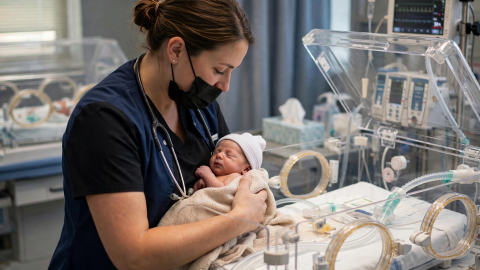
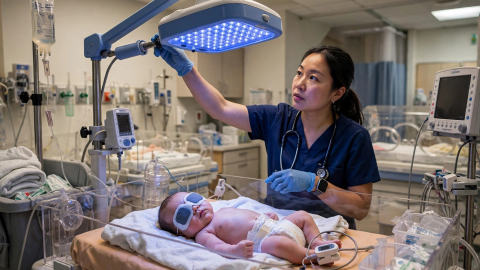
Overview
What this course sets out to do
- To teach neonatal fluid, electrolyte and glucose physiology by day of life and birth weight well enough for the nurse to question a prescription.
- To establish neonatal peripheral cannulation as a distinct skill, with vein selection, transparent securement, splinting without compression and documented limb visibility.
- To cover umbilical venous and arterial catheters and peripherally inserted central catheters: insertion assist, tip confirmation and accountability, complications and removal criteria.
- To implement the neonatal central line care bundle with hub discipline, minimised access events and a documented daily review of continuing necessity.
- To address infusion hazards at low rates, extravasation as an emergency, parenteral nutrition checks, iatrogenic blood loss from sampling, and transfusion nursing.
What your staff will be able to do
- Calculate and cross-check a neonatal daily fluid, electrolyte and glucose prescription against day of life, birth weight and measured output, and query what does not reconcile.
- Apply neonatal vascular access maintenance to protocol - securement, hourly limb visibility checks, documented line necessity - and deliver the central line bundle at every access event.
- Analyse an extravasation injury or a central line-associated bloodstream infection into infusate, site choice, dressing opacity, check frequency, access technique and hub handling.
- Evaluate the unit's umbilical and central catheter tip confirmation practice and determine whether accountability for confirming position is assigned to a named person before infusion begins.
- Construct a neonatal extravasation register and central line bundle with a vesicant list, staged injury grading, first actions, escalation route and line-day denominators.
Eligibility
Open to Level II and III neonatal and special newborn care unit nurses, NICU in-charge sisters and vascular access link nurses, all registered nurses holding valid State Nursing Council registration. Cannulation, line care and sampling require direct observation against a checklist by an experienced assessor on the unit's own equipment; the course certifies no competence.
Renewal & retraining
NABH expects annual refreshers and revalidation for high-risk roles, which includes this unit. Hours count toward the Indian Nursing Council requirement of 150 CNE hours per five-year cycle.
This is an annual requirement — staff must retrain every year and the certificate states when the next refresher is due. Inside the MedSkills LMS, expiring certificates are flagged automatically and refresher training is re-assigned before the due date.
Certification
Upon successful completion of this course, you will receive a tamper-proof digital certificate backed by blockchain technology from MedSkills. This secure, verifiable certificate validates your skills and can be shared on LinkedIn, added to your resume, or included in your professional portfolio.
Certificate Benefits
Blockchain-Backed Security
Tamper-proof certificates secured by blockchain technology
Instant Verification
Employers can verify authenticity instantly through blockchain
LinkedIn Ready
Share directly to your LinkedIn profile and resume
Digital Download
High-quality PDF certificate for printing
Global Recognition
Accepted by employers and institutions worldwide
Lifetime Access
Certificate remains valid and accessible forever
Certification Requirements
- Complete all course modules and assignments
- Achieve minimum 50% score in final assessment