Overview
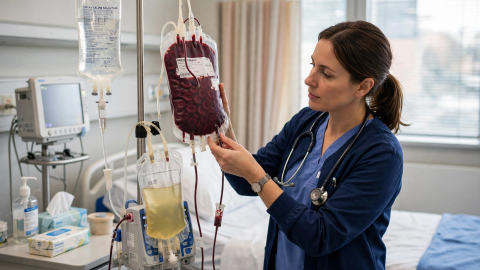
| A peripheral cannula is found in situ on day nine because nobody wrote the insertion date on the dressing or in the record, so no one owned the decision to remove it. On the same ward a central line dressing is changed when it looks dirty and the hub is accessed without being scrubbed. This course covers device selection, insertion, securement, the central line bundle, complication grading, extravasation and a device register. |
What this course sets out to do
- To match device and vein selection to expected dwell, infusate osmolarity and pH across the peripheral cannula, midline, PICC, central catheter and implanted port.
- To teach cannulation and central insertion assist with aseptic non-touch technique, maximal sterile barrier precautions and the nurse's authority to halt a procedure.
- To establish scheduled dressing, flushing, locking and hub disinfection, and the central line bundle with documented daily review of continuing necessity.
- To build timed recognition and response for phlebitis, infiltration, extravasation of a vesicant, occlusion, catheter-related thrombosis and air embolism.
- To prepare the unit to run a device register with dwell time and device days, and a direct observation competency checklist for the procedural steps.
What your staff will be able to do
- Select an appropriate vascular access device and site for a given therapy and infusate, and insert and secure a cannula with documented insertion date and gauge.
- Implement the central line maintenance bundle in full - scheduled dressing, hub disinfection with observed contact time, correct flush and lock, documented daily review of necessity.
- Differentiate phlebitis, infiltration, extravasation, occlusion and catheter-related thrombosis at the bedside, grading severity with the visual infusion phlebitis and infiltration scales.
- Appraise the unit's bundle compliance and device-day data against CDC and Infusion Nurses Society guidance and determine whether reported infection rates are credible.
- Construct a vascular access register and a direct observation competency checklist for cannulation and central line dressing change, with scored critical steps and a reassessment interval.
Eligibility
Open to staff nurses who cannulate, ICU, theatre, emergency and infusion nurses and infection control link nurses, all registered nurses holding valid State Nursing Council registration. Cannulation and central line care require direct observation against a checklist by an experienced assessor on the hospital's own equipment; this written course does not certify competence.
Renewal & retraining
NABH expects in-service training for all staff at least once a year. Hours count toward the Indian Nursing Council requirement of 150 CNE hours per five-year registration renewal cycle.
This is an annual requirement — staff must retrain every year and the certificate states when the next refresher is due. Inside the MedSkills LMS, expiring certificates are flagged automatically and refresher training is re-assigned before the due date.
Certification
Upon successful completion of this course, you will receive a tamper-proof digital certificate backed by blockchain technology from MedSkills. This secure, verifiable certificate validates your skills and can be shared on LinkedIn, added to your resume, or included in your professional portfolio.
Certificate Benefits
Blockchain-Backed Security
Tamper-proof certificates secured by blockchain technology
Instant Verification
Employers can verify authenticity instantly through blockchain
LinkedIn Ready
Share directly to your LinkedIn profile and resume
Digital Download
High-quality PDF certificate for printing
Global Recognition
Accepted by employers and institutions worldwide
Lifetime Access
Certificate remains valid and accessible forever
Certification Requirements
- Complete all course modules and assignments
- Achieve minimum 50% score in final assessment