Overview
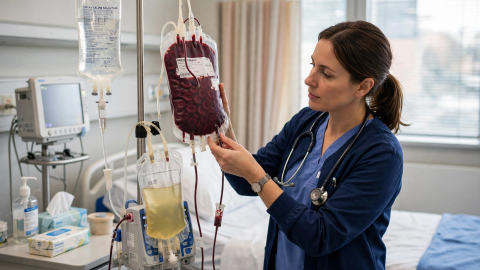
| Open the drug drawer on most Indian wards and the error is already built in: look-alike sound-alike vials side by side, concentrated potassium in ward stock, insulin drawn in a tuberculin syringe, a potassium infusion on a gravity set. Reciting the rights of administration prevents none of it. This course teaches administration as a system of defences - prescription review, independent double-check, high-alert controls, storage, calculation, devices, reconciliation and reporting. |
What this course sets out to do
- To teach the rights of administration and their limits, and the illegible, incomplete or ambiguous prescription that must be queried before it is given.
- To establish what makes an independent double-check genuine, and to apply it to the ISMP high-alert classes actually held in the unit.
- To build physical control of the drug store through tall-man lettering, segregation of look-alike sound-alike pairs and removal of concentrated electrolytes from ward stock.
- To equip nurses in dose calculation and units, infusion device selection, push rates, reconstitution, compatibility and the oral and enteral routes.
- To establish medication reconciliation, controlled drug custody under the Narcotic Drugs and Psychotropic Substances Act 1985, and error and adverse drug reaction reporting.
What your staff will be able to do
- Perform medication administration by each route against a verified prescription with two patient identifiers, correct calculation, correct device and complete documentation including any omitted dose.
- Perform a genuine independent double-check for high-alert medications, including independent recalculation, and demonstrate the segregation and labelling controls for look-alike sound-alike drugs.
- Analyse a medication error across prescribing, transcription, storage, preparation, administration and monitoring, identifying which defence was absent rather than which person failed.
- Appraise the unit's controlled drug custody, register and wastage practice against the Narcotic Drugs and Psychotropic Substances Act 1985 and determine whether a discrepancy would be detected.
- Design a high-alert medication control package and an administration observation audit tool with scored items for identification, double-check, labelling, rate control and documentation.
Eligibility
Open to staff nurses on inpatient wards, casualty, day-care and chemotherapy units, ward sisters responsible for ward stock and controlled drug registers, ICU nurses managing titrated infusions, theatre and PACU nurses, nursing superintendents, hospital pharmacists, quality managers and patient safety officers. Nurses must hold valid State Nursing Council registration.
Renewal & retraining
NABH expects in-service training for all staff at least once a year. Hours count toward the Indian Nursing Council requirement of 150 CNE hours per five-year registration renewal cycle.
This is an annual requirement — staff must retrain every year and the certificate states when the next refresher is due. Inside the MedSkills LMS, expiring certificates are flagged automatically and refresher training is re-assigned before the due date.
Certification
Upon successful completion of this course, you will receive a tamper-proof digital certificate backed by blockchain technology from MedSkills. This secure, verifiable certificate validates your skills and can be shared on LinkedIn, added to your resume, or included in your professional portfolio.
Certificate Benefits
Blockchain-Backed Security
Tamper-proof certificates secured by blockchain technology
Instant Verification
Employers can verify authenticity instantly through blockchain
LinkedIn Ready
Share directly to your LinkedIn profile and resume
Digital Download
High-quality PDF certificate for printing
Global Recognition
Accepted by employers and institutions worldwide
Lifetime Access
Certificate remains valid and accessible forever
Certification Requirements
- Complete all course modules and assignments
- Achieve minimum 50% score in final assessment