Overview
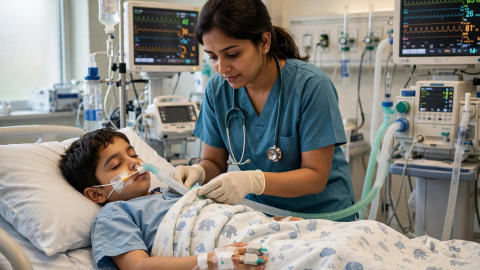
| A wheezing eighteen-month-old is given oxygen through an adult mask held loosely over his face by a tired mother, and nebulised with the chamber a foot away because he screams when it touches him. The chart records that oxygen and salbutamol were given; neither was, in any dose that matters. The course covers paediatric respiratory assessment, oximetry pitfalls, oxygen as a drug, the main conditions, inhaled therapy technique, airway clearance, tracheostomy and the oxygen-dependent child. |
What this course sets out to do
- To explain paediatric airway anatomy for its consequences, and to build the assessment sequence that identifies a child approaching respiratory failure.
- To establish pulse oximetry with its pitfalls and oxygen as a drug with a prescription, a sized delivery device and a monitoring requirement.
- To cover the nursing management of bronchiolitis, asthma, pneumonia, croup, aspiration and pertussis, with the IMNCI thresholds treated as a protocol matter.
- To teach inhaled therapy as a technique either performed correctly or not performed at all, with device and mask sizing, spacer care and parent return demonstration.
- To prepare nurses for airway clearance, childhood tuberculosis, non-invasive ventilation, tracheostomy emergencies, home oxygen and the Indian determinants of paediatric respiratory disease.
What your staff will be able to do
- Apply a structured paediatric respiratory assessment - rate for age, work of breathing, recession, flaring, grunting, stridor against wheeze, saturation - recorded so deterioration is visible from the chart.
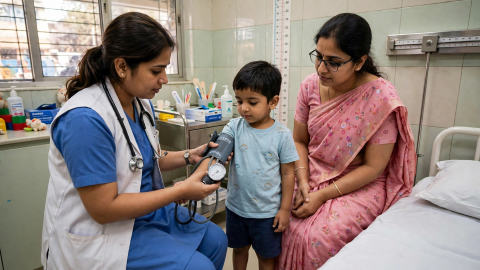
- Perform correct inhaled therapy by age using a sized spacer with mask or mouthpiece or a sealed nebuliser mask, and teach the same technique with a parent return demonstration.
- Distinguish upper from lower airway obstruction and compensated distress from imminent respiratory failure using the physical signs rather than the saturation reading alone.
- Evaluate the indication for suctioning, chest physiotherapy and escalation of respiratory support in an individual child, judging whether the intervention is indicated or is ward habit that will harm.
- Design a paediatric respiratory assessment competency checklist, an inhaler and spacer technique audit tool and a bedside tracheostomy emergency pack list with a blocked-tube action card.
Eligibility
For registered nurses with valid State Nursing Council registration on paediatric wards, paediatric intensive care and high dependency, paediatric emergency, asthma and respiratory clinics and newborn step-down units, with ward in-charges, respiratory therapists, physiotherapists, nursing tutors and paediatric residents. Suctioning, inhaler technique, high flow set-up and tracheostomy care require separate direct observation.
Renewal & retraining
NABH expects annual refreshers and revalidation for high-risk roles, which includes this unit. Hours count toward the Indian Nursing Council requirement of 150 CNE hours per five-year cycle.
This is an annual requirement — staff must retrain every year and the certificate states when the next refresher is due. Inside the MedSkills LMS, expiring certificates are flagged automatically and refresher training is re-assigned before the due date.
Certification
Upon successful completion of this course, you will receive a tamper-proof digital certificate backed by blockchain technology from MedSkills. This secure, verifiable certificate validates your skills and can be shared on LinkedIn, added to your resume, or included in your professional portfolio.
Certificate Benefits
Blockchain-Backed Security
Tamper-proof certificates secured by blockchain technology
Instant Verification
Employers can verify authenticity instantly through blockchain
LinkedIn Ready
Share directly to your LinkedIn profile and resume
Digital Download
High-quality PDF certificate for printing
Global Recognition
Accepted by employers and institutions worldwide
Lifetime Access
Certificate remains valid and accessible forever
Certification Requirements
- Complete all course modules and assignments
- Achieve minimum 50% score in final assessment