Overview
What this course sets out to do
- To teach cardiac and coronary anatomy against failure, so the nurse can predict which wall and which complication follows occlusion of a named vessel.
- To establish preload, afterload, contractility and heart rate as the four levers that every cardiac drug, fluid, device and ventilator setting manipulates.
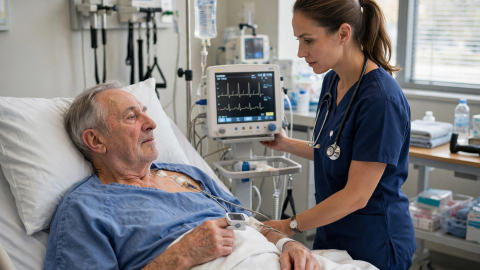
- To build the cardiac history and physical examination as a sequence - pulses, jugular venous pressure, apex, heart sounds, murmurs, oedema and perfusion - producing a defensible record.
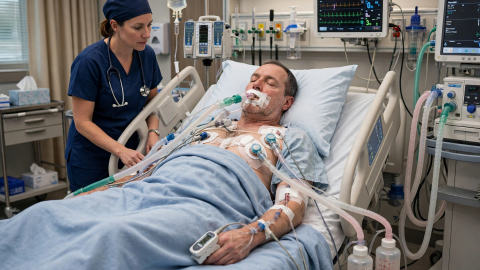
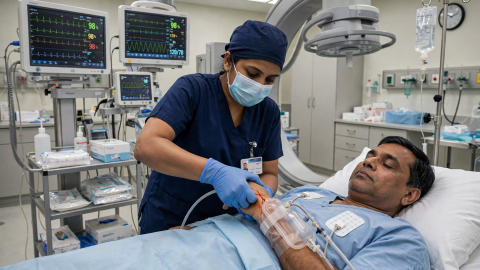
- To teach non-invasive and invasive haemodynamic monitoring with the measurement errors that generate most false escalations.
- To cover shock differentiation, biomarkers and imaging in context, and valvular, rheumatic and adult congenital heart disease with their nursing implications.
What your staff will be able to do
- Apply a structured cardiac nursing assessment to every cardiac admission in their own unit and record it in a form a colleague can act on at handover.
- Determine the haemodynamic effect of a fluid bolus, diuretic, vasodilator, inotrope or rhythm change using preload, afterload, contractility and rate before it appears on the monitor.
- Analyse a fall in blood pressure or cardiac output by separating volume, pump, rhythm, vessel and obstructive causes using the bedside examination and monitored variables.
- Interpret a haemodynamic reading to determine whether it reflects the patient or a measurement error in levelling, zeroing, damping, cuff size or catheter position.
- Construct a cardiac nursing assessment record and a bedside measurement troubleshooting aid covering transducer levelling, zeroing, square-wave testing and documentation of each value.
Eligibility
Open to staff nurses newly posted to a coronary care unit, cardiac ward, cardiac intensive care unit, catheterisation laboratory or cardiothoracic intensive care, ward and CCU nurses consolidating assessment, emergency department nurses receiving chest pain, cardiac in-charges, nursing superintendents and clinical instructors. Learners must hold valid State Nursing Council registration; examination technique requires observed sign-off.
Renewal & retraining
NABH expects annual refreshers and revalidation for high-risk roles, which includes this unit. Hours count toward the Indian Nursing Council requirement of 150 CNE hours per five-year cycle.
This is an annual requirement — staff must retrain every year and the certificate states when the next refresher is due. Inside the MedSkills LMS, expiring certificates are flagged automatically and refresher training is re-assigned before the due date.
Curriculum
Certification
Upon successful completion of this course, you will receive a tamper-proof digital certificate backed by blockchain technology from MedSkills. This secure, verifiable certificate validates your skills and can be shared on LinkedIn, added to your resume, or included in your professional portfolio.
Certificate Benefits
Blockchain-Backed Security
Tamper-proof certificates secured by blockchain technology
Instant Verification
Employers can verify authenticity instantly through blockchain
LinkedIn Ready
Share directly to your LinkedIn profile and resume
Digital Download
High-quality PDF certificate for printing
Global Recognition
Accepted by employers and institutions worldwide
Lifetime Access
Certificate remains valid and accessible forever
Certification Requirements
- Complete all course modules and assignments
- Achieve minimum 50% score in final assessment