Overview
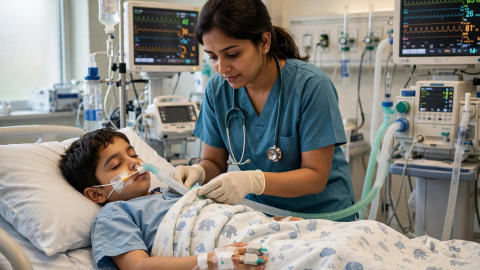
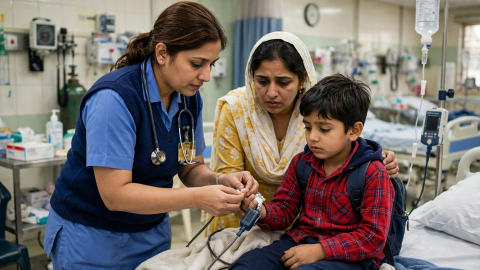
| A four-year-old is admitted to a paediatric ward and nursed as a small adult. The blood pressure is taken with the only cuff on the trolley, which is an adult cuff; the observation chart is the adult chart, with no column for work of breathing and no age band against which any number means anything. The equipment is present; the knowledge that makes it useful is not. The course rebuilds paediatric assessment, growth monitoring, nutrition, pain scoring and the child's response to hospitalisation. |
What this course sets out to do
- To establish why a child is not a small adult, taking each physiological difference through to what it changes about assessment and intervention.
- To teach growth and development by age band with the nursing approach, communication, consent, assent and use of play each stage dictates.
- To build growth monitoring and nutritional assessment as measured skills, from the growth curve to severe acute malnutrition and the Nutritional Rehabilitation Centre pathway.
- To establish age-specific vital signs, the systematic paediatric assessment, the history taken from a parent and pain scoring with named tools.
- To prepare nurses for the child as a ward occupant - separation anxiety, procedure preparation, play, the adolescent - and for the common conditions a ward nurse manages.
What your staff will be able to do
- Apply age-specific normal ranges for respiratory rate, heart rate, blood pressure and temperature to every child assessed, measuring each with correctly sized equipment and recording against the age band.
- Apply the WHO growth standards and Indian Academy of Pediatrics charts to plot weight, length, head circumference and mid-upper arm circumference, and identify faltering growth for referral.
- Analyse how a named physiological difference between a child and an adult changes a specific assessment finding, fluid tolerance or nursing intervention for that child.
- Assess the pain of a child with the appropriate named tool - FLACC, Wong-Baker FACES, numerical rating or a non-verbal scale - and judge whether analgesia and reassessment were recorded.
- Design a paediatric assessment record and age-banded observation chart for their own unit, with age-specific ranges, work-of-breathing and perfusion fields, pain score, growth parameters and escalation triggers.
Eligibility
Core for registered nurses with valid State Nursing Council registration newly posted to or working in paediatric wards, outpatients, paediatric emergency, newborn step-down and paediatric intensive care, with ward in-charges, nursing superintendents, nursing tutors and paediatric residents. Measurement and examination technique require separate direct observation.
Renewal & retraining
NABH expects annual refreshers and revalidation for high-risk roles, which includes this unit. Hours count toward the Indian Nursing Council requirement of 150 CNE hours per five-year cycle.
This is an annual requirement — staff must retrain every year and the certificate states when the next refresher is due. Inside the MedSkills LMS, expiring certificates are flagged automatically and refresher training is re-assigned before the due date.
Certification
Upon successful completion of this course, you will receive a tamper-proof digital certificate backed by blockchain technology from MedSkills. This secure, verifiable certificate validates your skills and can be shared on LinkedIn, added to your resume, or included in your professional portfolio.
Certificate Benefits
Blockchain-Backed Security
Tamper-proof certificates secured by blockchain technology
Instant Verification
Employers can verify authenticity instantly through blockchain
LinkedIn Ready
Share directly to your LinkedIn profile and resume
Digital Download
High-quality PDF certificate for printing
Global Recognition
Accepted by employers and institutions worldwide
Lifetime Access
Certificate remains valid and accessible forever
Certification Requirements
- Complete all course modules and assignments
- Achieve minimum 50% score in final assessment