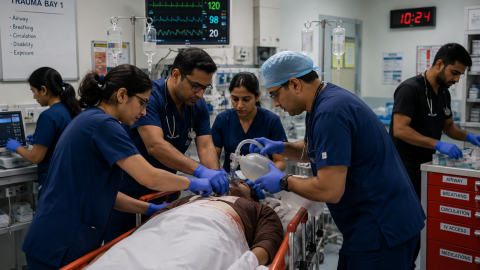
Disaster Management and Mass Casualty Incidents
Disaster preparedness and drills for a coordinated hospital response.
Overview
What this course sets out to do
- To explain the hospital incident command structure and who holds authority to declare an internal or external disaster on each shift of the week.
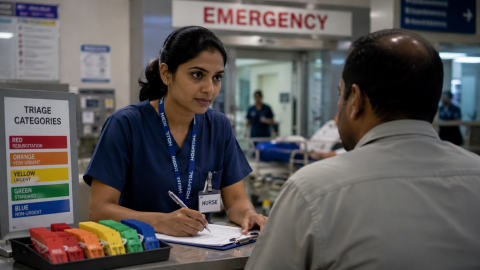
- To equip staff to apply mass casualty triage and tagging, whose purpose differs sharply from everyday emergency department triage.
- To establish surge capacity planning - bed release, staff recall, stores, linen, transport and mortuary arrangements - as a written and rehearsed sequence.
- To prepare hospitals to design, conduct and record disaster drills at the frequency required by NABH 6th Edition, including both internal and external scenarios.
- To build the discipline of converting drill findings into dated corrective actions with named owners instead of a report that is filed and forgotten.
What your staff will be able to do
- Apply mass casualty triage categories to a simulated multiple casualty arrival and justify each tag assigned against the available resources.
- Perform an assigned incident command role and identify the person to whom that role reports during a declared internal or external event.
- Design a drill plan, observer checklist and debriefing format for a mass casualty scenario relevant to the hospital's location and services.
- Evaluate a completed drill against the hospital's own plan and list the gaps found with proposed corrective actions, owners and dates.
- Assess a department's readiness - call tree, exits, triage area, stores and transport - and report the deficiencies to the disaster committee.
Eligibility
Open to all hospital employees, because a disaster response draws on clinical, administrative, security, housekeeping, engineering and transport staff alike. Department heads, disaster committee members, nursing superintendents and safety officers should complete it. No prior qualification is required. Role-specific duties are confirmed through the hospital's own plan and drills.
Renewal & retraining
NABH expects in-service training for all staff at least once a year, and annual refreshers with revalidation for high-risk roles.
This is an annual requirement — staff must retrain every year and the certificate states when the next refresher is due. Inside the MedSkills LMS, expiring certificates are flagged automatically and refresher training is re-assigned before the due date.
Curriculum
Certification
Upon successful completion of this course, you will receive a tamper-proof digital certificate backed by blockchain technology from MedSkills. This secure, verifiable certificate validates your skills and can be shared on LinkedIn, added to your resume, or included in your professional portfolio.
Certificate Benefits
Blockchain-Backed Security
Tamper-proof certificates secured by blockchain technology
Instant Verification
Employers can verify authenticity instantly through blockchain
LinkedIn Ready
Share directly to your LinkedIn profile and resume
Digital Download
High-quality PDF certificate for printing
Global Recognition
Accepted by employers and institutions worldwide
Lifetime Access
Certificate remains valid and accessible forever
Certification Requirements
- Complete all course modules and assignments
- Achieve minimum 50% score in final assessment