
NABH-aligned by design
Content mapped to the current accreditation standard, so training supports your compliance directly.
Helping hospitals improve efficiency and patient care through continuous learning and skill development — 100+ NABH-aligned courses, ready to assign to every clinical and non-clinical role.

Expert-led, NABH-aligned courses your teams can start today.
Upskill continuously and stay current with new skills and government norms.
Turn training into measurable outcomes — better care, fewer errors.
We focus on the outcomes that move the needle for your hospital — not generic training. Every course ties back to results you can measure.
Assign mandatory training, track completion in real time and keep audit-ready evidence.
Standardise skills across nursing and clinical staff, from ward to ICU.
Safer medication, procedures and handovers through consistent, assessed practice.
Better communication and service that lifts satisfaction scores and trust.
Faster onboarding and less time lost to fragmented, repeated training.
Keep teams current with new clinical skills and changing government norms.
Consent, documentation and MLC training that reduces liability and litigation risk.
Clear growth paths and continuous learning keep nurses and clinical teams engaged — reducing costly attrition.
Deliver the same protocols and training quality across every ward, department and branch.
Most hospitals juggle scattered PDFs, one-off workshops and no record of who was trained. MedSkills replaces all of it with a platform and content library built only for healthcare.
Content mapped to the current accreditation standard, so training supports your compliance directly.
Assign the right courses to nurses, doctors, housekeeping and admin — automatically.
See who has completed what, with certificates and audit-ready reports on demand.
An off-the-shelf library plus bespoke e-learning built from your own SOPs and protocols.
Learning that works on the phones your staff actually use, at any hour.
Your logo, your colours — a learning platform that feels like your hospital's own.

Look-alike sound-alike vials sit together in the same drawer, concentrated electrolyte is stored loose on the ward, and a high-alert infusion is started on one nurse's calculation with nobody checking it. This course follows the medication use process from prescription to monitoring: LASA and high-alert identification, segregated storage and labelling, independent double-checks, verbal order read-back, narcotic records under the Drugs and Cosmetics Rules, and reporting of errors and adverse drug reactions.

OT infection control is usually taught as scattered fragments - a hand hygiene session here, a CSSD talk there - in the highest-consequence infection environment in the hospital. This course treats the theatre complex as one controlled system: zoning, traffic and attire; pre-operative preparation and antibiotic prophylaxis; intra-operative asepsis; environmental hygiene and air quality; the CSSD interface; and post-operative surveillance. Built on WHO and CDC surgical site infection guidance, NCDC national IPC guidelines and the NABH 6th Edition IPC and COP chapters.

The checklist is read aloud by a nurse while the team carries on working, and sign-out is skipped because the surgeon has already left the theatre. This course treats the three pauses of the WHO Surgical Safety Checklist as a team conversation rather than a form: sign-in, time-out and sign-out, who must stop and listen, identity, consent and site marking verification, specimen labelling, instrument and swab counts, anaesthesia checks, and theatre discipline and traffic.
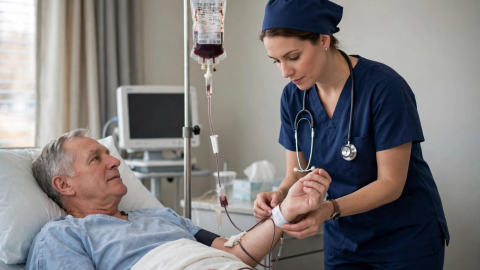
The patient safety goals are read out at induction and then absent at the bedside: a wristband nobody checks before a transfusion, a shift handover that loses the potassium infusion, an unmarked site because the surgeon always knows. This course works through correct patient identification, effective clinical communication and handover, safe use of high-alert medication, correct site surgery, infection risk reduction and fall risk, as they are actually practised on an Indian ward.
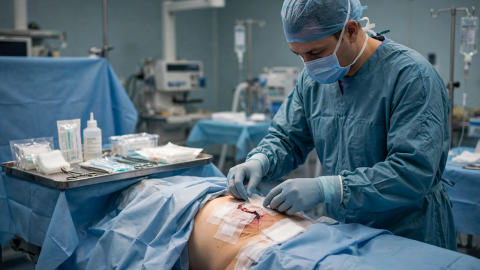
Most hospitals report a surgical site infection rate. Very few can defend how it was calculated - the denominator is unclear, case-finding is passive, and post-discharge follow-up, where many infections appear, is skipped entirely. This course builds genuine surveillance capability: standard case definitions, wound class and risk index, correct denominators, structured case-finding, honest rate calculation, run and control charts for small volumes, and the bundle compliance audit and surgeon feedback loop that moves the rate.
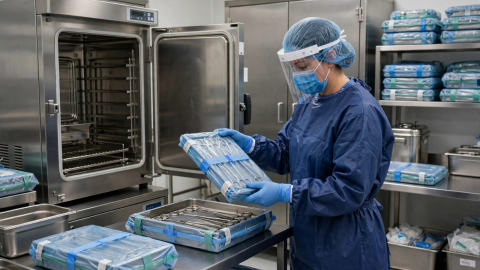
A cycle printout is filed with nobody reading the parameters on it, loads are released because the autoclave finished, and instruments reach the department with blood dried on them because point-of-use treatment was skipped in theatre. This course follows the instrument through decontamination, cleaning, inspection, packing, sterilization, storage and issue: zoning and unidirectional workflow, cleaning validation, physical, chemical and biological indicators, load release criteria, packaging integrity, shelf life and recall.

Infection control training is often delivered once a year to a hall of staff who sign the attendance sheet and return to practice unchanged. NABH expects in-service infection prevention training at least once a year for every category of staff, and this is the course written to meet it: standard and transmission-based precautions, hand hygiene, personal protective equipment, safe injection practice, device-associated infection, environmental cleaning, waste segregation under the Bio-Medical Waste Management Rules 2016, and outbreak response.

Most hospitals prepare for accreditation by writing policies and then carry on working as before, so the assessor finds a manual that no ward follows. The 6th Edition took effect on 1 January 2025. This course orients the whole hospital to it chapter by chapter - AAC, COP, MOM, PRE, PSQ, IPC, FMS, HRM, IMS and ROM - setting out what each chapter expects of daily practice, which post owns it, and what evidence routine work should already be generating.
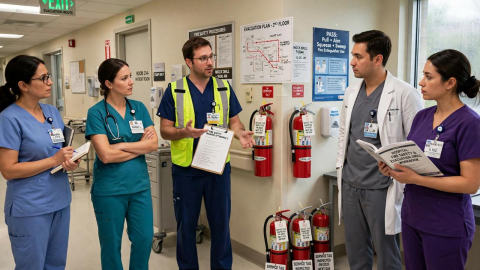
Every extinguisher on the floor carries a current service tag, and most of the staff standing next to them have never taken one off its bracket. The evacuation plan is on the wall; moving a bedbound patient down a staircase has never been attempted. This course covers fire behaviour in a hospital, extinguisher and hose use, alarm response, horizontal and vertical evacuation, and the drill and Fire NOC record-keeping the MoHFW advisory circulated by NABH expects: drills twice a year, NOC renewed annually.
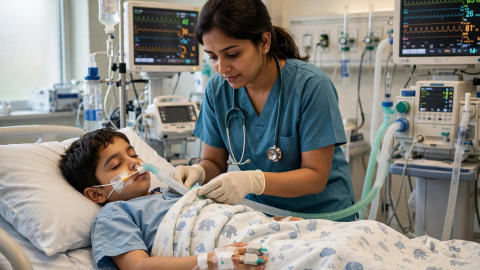
A three-year-old is seen in casualty with two days of diarrhoea. He is tachycardic, his hands are cold to the wrist, capillary refill is prolonged and he has not passed urine since morning. His blood pressure is normal, so he is sent to the ward, where he arrests. The course covers recognition, early warning scoring, triage, shock, status epilepticus, poisoning, burns, trauma, resuscitation principles, trolley preparation and the aftermath.
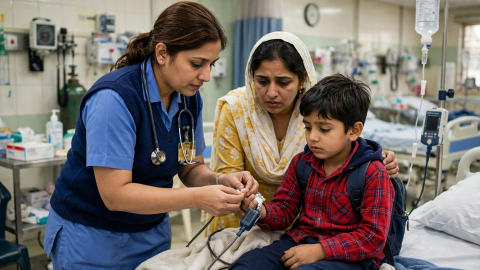
A wheezing eighteen-month-old is given oxygen through an adult mask held loosely over his face by a tired mother, and nebulised with the chamber a foot away because he screams when it touches him. The chart records that oxygen and salbutamol were given; neither was, in any dose that matters. The course covers paediatric respiratory assessment, oximetry pitfalls, oxygen as a drug, the main conditions, inhaled therapy technique, airway clearance, tracheostomy and the oxygen-dependent child.

A ten-month-old receives ten times the intended dose because a decimal point moved between the prescription and the syringe. In the same week, on the same ward, a child is dosed from a weight taken eight days earlier, another from a weight the mother guessed at triage, and a third from no recorded weight at all. The course covers weighing, weight-based and surface-area dosing, dilution and small volumes, oral liquids, the independent double-check, immunisation and intravenous access, and fluid therapy.
Each course is priced individually · certificate on completion · see all 100+ courses across 11 categories →
We set up your branded LMS and import your staff and departments.
Map mandatory and upskilling courses to each role in a few clicks.
Your team completes courses and assessments on mobile or desktop.
Monitor completion, issue certificates and export audit-ready reports.
Departments, role-based paths, compliance tracking and certification management — ready on day one and whitelabelled to your brand.
Send us your SOPs and clinical protocols and we build customised, SCORM-ready e-learning — narrated, interactive and delivered inside your LMS.
Tell us about your hospital's training and compliance goals and we'll put together a plan — including a demo of the LMS with e-learning content for hospitals. No cost, no obligation.
We respond within 24 hours.
Yes. Courses are mapped to the current NABH standard and mandatory statutory training, and the LMS tracks completion and certificates so you have audit-ready evidence for assessment.
Yes — we have a dedicated medico-legal & regulatory category covering informed consent, medico-legal cases (MLC) and police cases, medical negligence, death certification, PC-PNDT, the Clinical Establishments Act and the DPDP Act 2023. These areas are a frequent source of hospital liability, and the training is designed to help you avoid medico-legal complications.
Absolutely. The LMS is whitelabelled with your logo and colours, so it feels like your hospital's own learning system.
Yes. Our content studio converts your SOPs and protocols into engaging, SCORM-ready e-learning modules delivered inside your LMS.
Each course is priced individually (the price is shown on its course page) and includes assessment and a certificate. Bundled and volume pricing is available for whole-team, multi-department and multi-branch rollouts.
Request a demo and we'll set up a branded environment, help you map role-based learning paths and get your team enrolled.
Bring every course, every certificate and every record onto one platform — the LMS with e-learning content for hospitals. 100+ courses, whitelabelled to your brand.